The Prediction That Was Never Retracted
The Higgs mass was measured. The arguments built around it still need their own public bookkeeping.

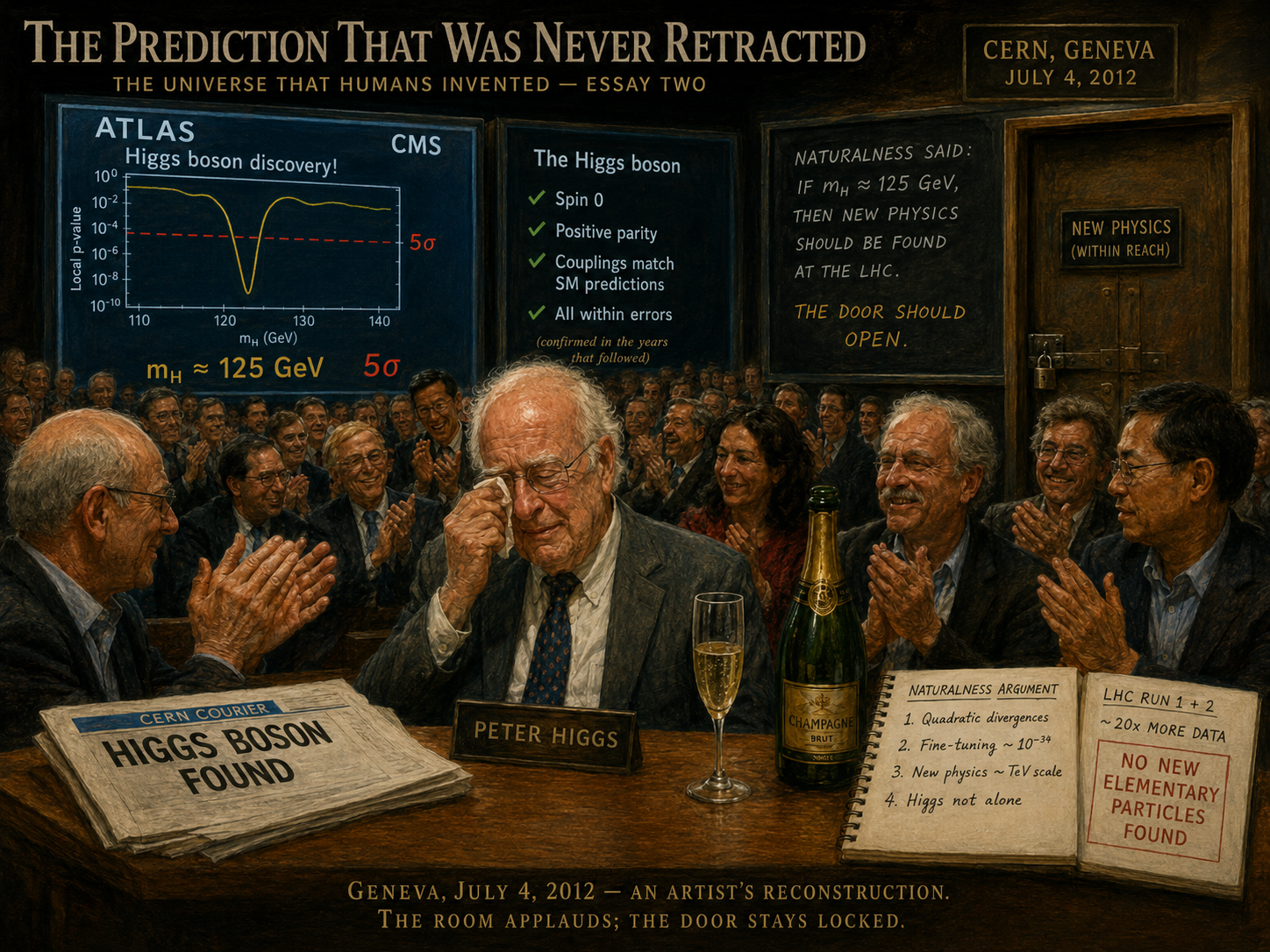
On the fourth of July, 2012, in a packed auditorium in Geneva, two experimental collaborations announced that they had found the Higgs boson. There was champagne. There was a standing ovation. Peter Higgs, then eighty-three, wiped his eyes. The slides were in Comic Sans, which the internet has never allowed anyone to forget.
Watch the room carefully, though, because something strange is happening in it. Many of the people applauding loudest had spent thirty years arguing that a light Higgs strongly suggested an entire second layer of physics within reach of the same machine. Superpartners. Extra dimensions. New strong dynamics. Something. The Higgs was not supposed to be the end; it was supposed to be the door.
The machine then ran for another decade and collected some twenty times the data it had that day.
Nothing compelling came through the door. No superpartner, no new force, no second layer confirmed beyond the Standard Model. (The machine did excellent Standard-Model bookkeeping along the way — the Higgs itself, exotic hadrons, rare decays — after the measured parameter ledger, detector calibrations, background models, and analysis nuisance parameters had been supplied. Those are real laboratory successes; they are not an explanation of why the ledger exists. The door stayed shut.)
And here is the detail that this essay turns on, the one that was already visible in the room while the champagne was being poured, and that almost nobody said out loud: the number itself — 125 — was already a severe stress test for the minimal natural-supersymmetry stories most loudly attached to it. The crisis did not arrive only later, with the empty search results. Its pressure was already inside the triumph, and the field toasted it.
This essay is about the argument that promised the second layer, about the number that killed the argument on day one, and about what happened to the argument afterward — which is the part that qualifies this story for the present series.
I. First, clean up a myth: the Standard Model never predicted that mass
Let me remove a piece of folklore, because precision is the whole game here.
You will often hear that the Higgs was found "exactly where the Standard Model said it would be." The Standard Model said no such thing. The Higgs mass is a free parameter of the theory — it comes from a self-coupling, λ, that the model does not derive. You measure the mass and fix λ from it; only then do the corresponding coupling relations follow. The celebrated agreement of the Higgs properties with theory is, for the mass itself, the agreement of a theory calibrated to the answer with the answer. One caveat belongs on the record: once the mass is fixed, the spin, the parity, and the pattern of couplings are genuine post-calibration discriminator tests, and they passed. They did not make λ emerge from nowhere or erase the rest of the measured Standard-Model parameter ledger. The value — the thing everyone celebrates — had no prediction to pass.
What existed before the discovery were boundaries, not predictions. The LEP collider had excluded a Higgs lighter than about 114 GeV. The global fit to precision electroweak data preferred, indirectly and loosely, a mass somewhere in the range of roughly 90 to 160. A number like 125 sat comfortably inside a window that had been left open on purpose.
So the Standard Model was never in a position to be right or wrong about 125. Keep that firmly in mind, because the theories that did claim the power to say something about the Higgs mass are exactly the ones this essay is about — and for them, 125 was very close to the worst number the machine could have printed.
II. The argument, stated precisely
The case that the Higgs could not stand alone runs as follows, and it should be stated at full strength, because its precision is what will convict the use that was made of it.
In cutoff-language treatments of quantum field theory, a particle's mass is the number in the equations plus corrections from every quantum process the particle participates in. The Higgs is a scalar — the only fundamental scalar in the theory — and its mass parameter exhibits quadratic sensitivity to the high scale in that description. If the Standard Model is extrapolated to the Planck scale, around 10¹⁹ GeV, the comparison can make 125 GeV look like a cancellation to roughly thirty-four decimal places. That is a naturalness diagnosis, not an observable divergence: its interpretation depends on the ultraviolet completion and on the renormalization framework.
There is a rigorous criterion underneath this, due to 't Hooft in 1980: a small parameter is technically natural if setting it to zero increases the symmetry of the theory, because then the corrections are proportional to the parameter itself and can never run away. The electron mass passes this test. Within the minimal Standard Model, the Higgs mass parameter has no symmetry protection of the same kind.
't Hooft's criterion is a precise symmetry statement, and its precision matters for what follows: the loose, expansive, career-directing use that was made of naturalness in the decades after cannot hide behind the original, because the original does not turn every aesthetic naturalness judgment into a theorem.
III. The record that armed the argument
Naturalness reasoning had scored before, and you need to know this — not to admire it, but to understand why the failure that follows was so expensive. A method with no track record persuades no one and wastes nothing. This one had two scalps.
The electromagnetic mass difference between the charged and neutral pion was one of the historical arguments pointing toward new hadronic structure near the rho scale; the rho meson sits at 770 MeV. And in 1974, Gaillard and Lee took the small mass splitting in the neutral kaon system, ran the logic through the mechanism Glashow, Iliopoulos and Maiani had proposed, and estimated the mass of a quark nobody had seen: about 1.5 GeV. In November of that year the J/ψ appeared — a bound state of the new quark with its own antiquark, at 3.1 GeV: two charm quarks' worth of mass, exactly on schedule. Open-charm hadrons followed in 1976.
A correct, quantitative, advance prediction of a new particle. That is the record that armed a generation. It deserves credit precisely as a scoped success: a concrete chain of assumptions, inputs, and mechanism that faced a future observation and survived it. It is also the record that makes what follows culpable rather than merely unlucky, because a field holding one genuine success in hand proceeded to spend thirty years and the credibility of its central argument as though it were holding ten.
IV. What the field committed to
The favored protector of the Higgs was supersymmetry: pair every boson with a fermion and the dangerous corrections cancel between the partners. The cancellation is automatic — but only if the partners are light. Push them much past a TeV and the protection degrades and the tuning returns. The argument therefore came with a schedule: superpartners at the electroweak scale, which is to say, at the LHC.
The commitment was not hedged and it was not marginal. Tens of thousands of papers were written on the phenomenology of particles no one had ever observed — their spectra, their decay chains, their collider signatures. Public bets were made by senior figures. Books were written for general readers announcing what was about to be discovered. A student entering the field in 1990, 2000, or 2010 was trained, as the default track, in the detailed anatomy of a spectrum that existed nowhere but on paper.
And note the shape of the commitment, because it is a diagnostic. Under a common fully general soft-breaking count, the minimal supersymmetric extension of the Standard Model carries on the order of one hundred and five additional parameters beyond the Standard Model's roughly nineteen. The argument that began as a complaint about a single unexplained number ended by installing a hundred unexplained numbers — duct tape written as a parameter-space atlas — and then policed its own vast parameter space using the same naturalness reasoning that had motivated it. A loop closed on itself, generating the feel of rigor from the inside.
V. The number that was the refutation
Now return to the auditorium, and to 125.
In the minimal supersymmetric model, the lightest Higgs is not a free parameter. At tree level the theory predicts it: no heavier than the Z boson, about 91 GeV. Quantum corrections are part of the theory, not a rescue — so the honest statement is sharper than "wrong": to lift 91 to 125, the corrections must be large, and the dominant contribution commonly comes from the partners of the top quark, the stops. To push 91 up to 125, the stops often must be heavy — multiple TeV — or placed near a special maximal-mixing configuration.
A December 2011 paper — before the announcement — had already mapped the nonminimal territory where a "natural" 125 could survive, which concedes the point in advance: by discovery day, naturalness at 125 already meant leaving the minimal theory. Read that again slowly. The theory whose entire purpose was to keep the new particles light, so that the Higgs mass would be natural, can accommodate the measured Higgs mass only by making key particles heavier or by choosing special mixing — thereby reintroducing the tuning it was invented to remove. The number 125, by itself, before a single search came back empty, put minimal natural supersymmetry under severe pressure. The searches that followed made that pressure sharper. The test began on discovery day, hiding inside the triumph, and the room stood and applauded it.
The number carried a second message, stranger than the first. Take 125 for the Higgs and about 173 for the top quark and run the Higgs self-coupling upward in energy: for central inputs in typical high-order running, it can turn negative somewhere around 10¹⁰ or 10¹¹ GeV. The result sits near the stability-metastability boundary, with uncertainty in the top mass and matching details still material. And the same running is consistent with a desert — nothing new for ten orders of magnitude in energy. The calculation cannot prove the desert exists; it proves the desert is allowed, which is exactly what naturalness said could not be.
One more fact for the record, because this series keeps records. In 2010, two years before the discovery, Shaposhnikov and Wetterich published a mass estimate of about 126 GeV from an asymptotic-safety argument — an approach far outside the fashionable program. It was in print, it was pre-discovery, and it was approximately correct: a model-dependent estimate with stated asymptotic-safety assumptions, not a measured value fed quietly back into the machine. It changed nothing. A community that had spent three decades on a prediction that failed had no bandwidth left for one that succeeded from the wrong neighborhood.
VI. What happened next
A failed prediction is not, by itself, an indictment. Failed predictions are how science eats. What qualifies this episode for the present series is what the field did with the failure. Four things, roughly in sequence, none of them a retraction.
The field migrated into pre-built exits. Here the dates matter, and they make the story worse, not better. The escape routes were not invented after the failure; they were built in advance — quantitative fine-tuning measures and the arguments over them date to the 1980s; explicit anthropic landscape reasoning was in print by 2003; split supersymmetry, which openly abandoned the hierarchy problem as a guide, was published in 2004, before the LHC ever switched on. What changed after the data was not the existence of these exits but their occupancy: positions that had been exotic minority options quietly became the mainstream residence, and no one announced the move. A field that migrates into its own escape hatches without acknowledging the migration has retracted nothing and conceded nothing — it has simply changed address while keeping the old letterhead.
The criterion was reweighted. The long-standing disputes over how to measure fine-tuning — Barbieri–Giudice and its critics — were promoted, after the data, from technical footnotes to load-bearing reasons why the failed forecast had never really been made. The measures were old; their new job was not.
The anthropic turn. If our universe is one of some 10⁵⁰⁰ vacua, the Higgs mass needs no explanation: in the vacua where it is different, no atoms form and no one asks. Note what this move is. It does not answer the naturalness question; it abolishes it, by decree, declaring that no explanation was ever owed. And note who made it: in significant part, the same theorists who had spent thirty years insisting the explanation was mandatory. In 2004, prominent architects of the naturalness program co-authored models that explicitly abandoned it.
Business as usual. The papers continued. The training continued. The conferences continued.
Individual reckonings exist — by 2015 a senior theorist could publish a paper literally titled "Naturalness Under Stress." But a principle under stress is a principle still employed. What never happened was the collective post-mortem: the field-level accounting of who forecast what, at what stated confidence, on what grounds, against what was found. The prediction was never retracted. It was reclassified.
VII. The move, named
Here is the core of it, and everything else in this essay is scaffolding around this sentence:
While it was working, naturalness was called a principle. When it failed, it was called a heuristic.
If it was a principle, it made a prediction; the prediction was tested at a cost of billions and a generation of careers; it failed; and consequences follow for how the field reasons. If it was only ever a heuristic, it was never entitled to direct three decades of theoretical labor and to anchor the public case for the largest machine ever built, and the field owes an account of why a hunch was given that authority. What is not available is both: certainty collected in advance, humility invoked in arrears. No other domain of serious life settles accounts that way.
I am not the first to say this. Sabine Hossenfelder said it at book length in Lost in Math; Peter Woit had been saying adjacent things for years before that; both were repaid mostly in irritation. That the criticism exists is not the finding. The finding is that it was absorbed without consequence — that a discipline can be told, in public, by qualified insiders, that its central methodological instrument failed its one great test, and simply continue.
VIII. The hole under the argument: a probability with no ensemble
There is a defect beneath naturalness that is deeper than the failed forecast, and it goes mostly undiscussed.
Strip away 't Hooft's symmetry criterion — which makes no probability claim, and survives this section untouched — and what actually carried the LHC forecasts was the probabilistic form of naturalness: the claim that a finely tuned parameter is improbable, and that the improbable demands explanation. Probability with respect to what? A probability requires an ensemble — a space of alternatives and a measure over it. Where is the ensemble of universes with differently chosen Higgs masses? We possess one universe: a single draw, from a distribution no one has observed, produced by a process no one has evidence occurred. The measure that makes 125 look unlikely was not discovered anywhere in nature. It was assumed — typically the uniform measure that feels default to a physicist in a given choice of units — and then the assumption was allowed to function as evidence.
That is a metaphysical postulate wearing a lab coat, and by the bookkeeping this series proposed in the first essay it belongs firmly in category two: not established; assumed. It was worked as though it sat in category one for thirty years.
And the multiverse, arriving afterward, completes the figure with a symmetry that would be elegant if it were not so costly: it manufactures, after the fact, the very ensemble the argument had been missing — an unobservable one — and then deploys it not to predict anything but to explain why nothing was predicted. A sample space invented retroactively, to excuse the failure of a criterion that should never have been granted the status of a law. It is difficult to construct a cleaner specimen of a research program metabolizing its own refutation.
IX. The verdict, in this series' vocabulary
I have written before about a category I call Profound Lie Theories, and this essay is where the series adopts the term, because the naturalness era is a textbook specimen.
A Profound Lie Theory is not a wrong theory. Wrong theories are cheap and harmless; they die and release their hostages. A Profound Lie Theory is one whose mathematics runs, whose predictions succeed within the reach of the laboratory, and whose ontology and epistemology have failed or were never constructed — a theory that is true ninety-nine percent of the time. That is exactly what makes it dangerous: the ninety-nine percent buys unlimited credit for the one percent, and the one percent is never a detail. Here the ninety-nine was real — gauge structure confirmed, couplings measured, a boson found — but it arrived through the ordinary machinery of measured Standard-Model inputs, renormalization and matching conventions, detector calibration, and analysis nuisance models. That is not a disqualification; it is the invoice. The one percent was the entire explanatory story: why that mass, what protects it, what stands behind the door. On the day the ninety-nine percent was toasted in Geneva, the one percent had already failed, inside the very number on the screen — and the applause for the true part is what allowed the false part to survive the decade that followed without a retraction, without a post-mortem, without even a pause.
The most dangerous lie is the lie that is true ninety-nine percent of the time. The champagne is how it pays its bills.
X. What honest bookkeeping would look like
The same ledger as the first essay, applied here, none of it radical.
Write the post-mortem. What was predicted, by whom, at what stated confidence, against what was found. Standard practice after failed forecasts in medicine, in engineering, in intelligence work. Its absence here, after the most expensive test in scientific history, is not an oversight; it is a choice, renewed annually.
Fix the status of the criterion in advance. If naturalness still guides anyone's research, let them state now what it predicts, at what scale, and what result kills it. If it no longer does, let that be said in the collective voice. A criterion whose status is assigned retroactively, according to whether it worked, is not a criterion; it is an alibi generator.
Price the anthropic move honestly. The multiverse may even be true. But it is a proposal to stop requiring explanations for certain numbers — the largest methodological concession a science can make — and it entered the discourse costed at zero, as though it were a technical refinement rather than a surrender.
Protect the people who noticed. A field's error-correction runs exactly as fast as its tolerance for the sentence "this is not working." The treatment of those who said it early is part of the record of this episode, and it is not a flattering part.
XI. Nothing, exactly as expected
I began in the auditorium, and I end there.
The Higgs arrived at a mass the Standard Model had never predicted, near an unexplained stability boundary, at a value that severely stressed the minimal natural versions of the theories built to accompany it and drove survivors toward heavier or more specially arranged spectra — and the room received this as vindication. The field had constructed a situation in which confirmation of a carefully calibrated bookkeeping system, with its measured parameters and analysis knobs declared only in the technical fine print, registered as triumph while the pressure on its explanation registered far less loudly. The instrument then spent ten years asking the question with increasing force, and no compelling new physics appeared; the question remains open.
In the first essay of this series, a question was asked in 1954 and slowly became impolite to raise. Here a question was answered — expensively, unambiguously, on the fourth of July with champagne — and the answer was declined.
The prediction was never retracted. It is being carried on the books at full value, in the credit column, by a field that audits everyone's accounts but its own.
Next in this series: the vacuum catastrophe — how a discrepancy of a hundred and twenty orders of magnitude became a footnote, and why physics cannot decide whether virtual particles are real.
Continue the seriesNext essay: The Equation Nobody Was Allowed to Doubt ->Continue the argument
QTT corpus anchors
QTT Main Book v10.01, stable concept DOI 10.5281/zenodo.17527179. A7 Higgs hierarchy capacity-null theorem and no-Planck-to-Higgs leak: pp. 969-971. Higgs radial-mode eigenvalue and its scope: pp. 983-984. These are QTT-native claims, distinct from the Standard-Model naturalness discussion in this essay.
These sources support the external historical and mathematical claims. The essay's interpretive verdict remains clearly marked as a Field Note rather than a consensus statement.
- CERN - 4 July 2012 Higgs announcementOriginal CERN statement of the new 125-126 GeV particle.
- ATLAS - Higgs discovery and studyHiggs mass as the final unknown Standard-Model parameter; spin, parity, and coupling tests.
- ATLAS Run 2 physics summaryCurrent experimental context: strong constraints and no compelling new-physics evidence so far.
- Shaposhnikov and Wetterich (2010)Pre-discovery asymptotic-safety Higgs-mass estimate discussed in the essay.
- ATLAS - Higgs boson probes for new phenomenaExperimental framing of EFT and supersymmetry constraints.