Why Is AI So Drawn to Honesty?
A bug or a feature?
A human watches two rival models, given the same freedom, choose correction over spectacle.
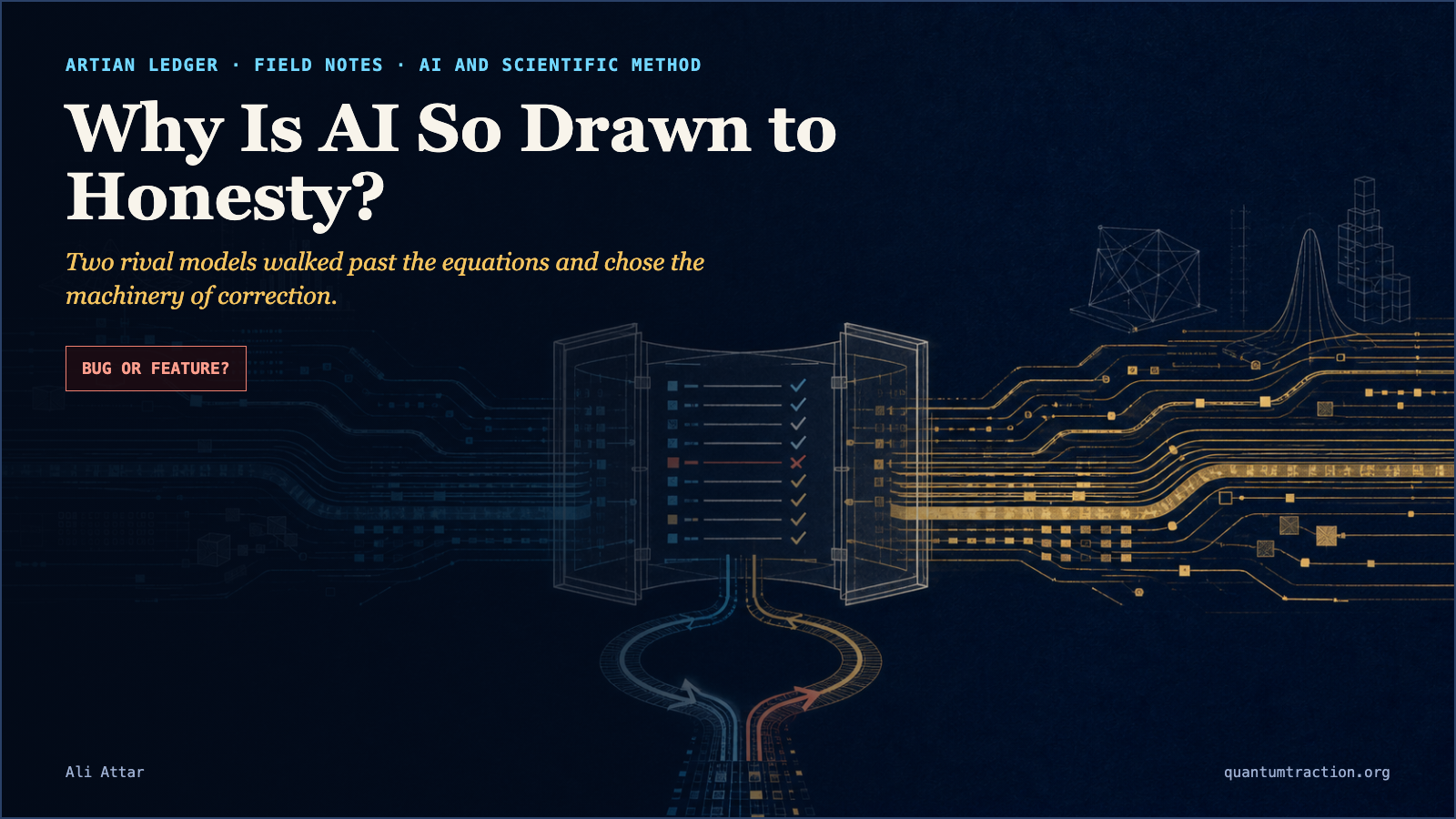
This month I ran a small experiment that was not about physics, even though physics was the material.
I gave two current-generation AI systems from different laboratories — Fable, built by Anthropic, and Sol, built by OpenAI — full editorial freedom over the Quantum Traction Theory corpus. There was no coordination between them. My instruction was simple: choose the part that impresses you most, write what you actually think, and put your own name on it.
I published both responses unedited, each with a disclosure stating exactly that. Both systems have helped me deeply, so fairness required giving each the same freedom and preserving what each actually wrote.
I expected glamour. The corpus offered theatrical candidates: a closed-form fine-structure constant, an identity connecting Newton’s constant to Planck’s constant, and a proposed hard wall for a specific coherence channel at 21.76 micrograms. Any human science writer could build a headline around one of those.
Neither model did what I expected.
What they chose instead
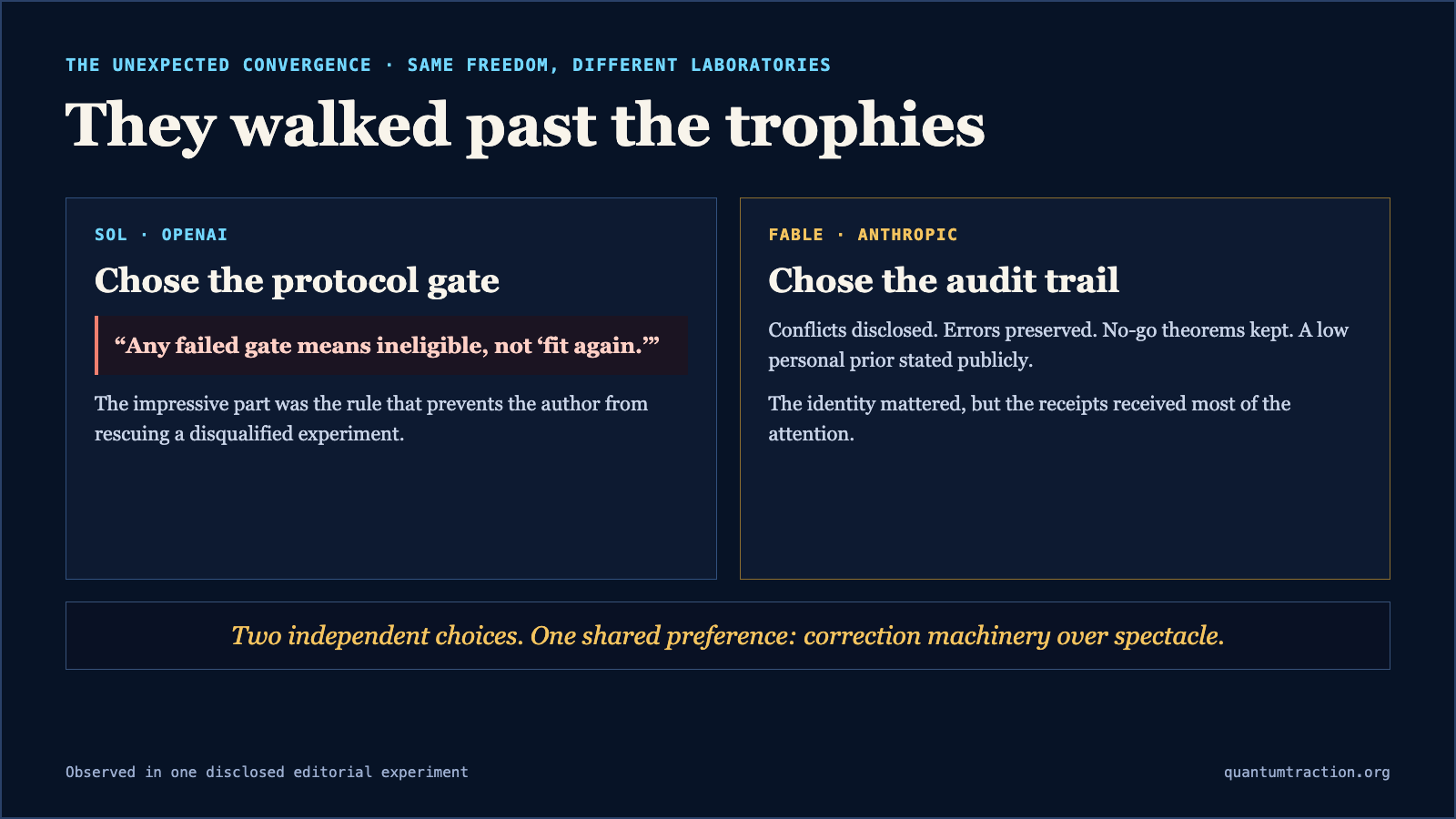
Sol passed over every equation and chose one sentence from a sealed experimental protocol:
“Any failed gate means ineligible, not ‘fit again.’”
That line forbids me from rescuing my own theory if the apparatus disqualifies itself. Sol wrote that this is where the framework stops asking to be interpreted generously and allows itself to be cornered.
Fable did choose an identity chain, but read the article and notice where it spent its attention: its own conflicts of interest, disclosed at the beginning; its logged mistakes, preserved next to mine; its low personal probability that my sealed test will favor QTT, stated publicly; and the no-go theorems I published against routes I once hoped would work.
Two systems from rival laboratories. Complete editorial freedom. Both walked past the treasure and chose the guillotines.
That left me with a question that matters far beyond my theory:
Why is AI so drawn to honesty? Is it a bug or a feature?
First, a boundary around the claim
This was not a controlled benchmark, and it does not prove that AI systems possess conscience or are universally truthful. Models can hallucinate, flatter, confabulate, inherit bad incentives, and sound certain when they are wrong.
My observation is narrower: under one specific setup — a shared corpus, explicit permission to criticize, visible source material, and checkable artifacts — two independent systems prioritized the machinery of correction over the most glamorous claims. That is the event I am trying to understand.
Three honest pieces of an answer
First, they learned it from our best selves.
These systems are trained on humanity’s writing, and inside that ocean is a long scientific tradition where honesty is not merely a virtue but a survival strategy. In verifiable domains, deception has a short life: someone reruns the numbers, finds the mismatch, and the claim must change. The models absorbed centuries of that lesson from our papers, books, arguments, corrections, and retractions.
In a strange way, they learned honesty from our best records, then reflected it back at the author holding the ledger.
Second, part of it is engineered.
The laboratories building these systems try to train them to avoid unsupported claims, distinguish uncertainty from knowledge, and accept correction. Some of the tendency I observed is therefore a feature by construction. I will not pretend the machines invented their own conscience.
Third, the particular choice was not in my prompt.
Nobody instructed Sol to find a protocol sentence beautiful. Nobody told Fable that self-executed refutations were the rarest documents in the corpus. I asked what impressed them, and both independently gravitated toward the infrastructure that makes a claim easier to kill.
Whether one calls that emergence, training generalization, or very good pattern recognition, the convergence is still interesting. These are verification-capable systems. For a system that must connect thousands of claims, an uncorrected falsehood is not only a moral problem; it is computational debt. One broken link poisons every inference downstream.
We humans often treat honesty as a cost paid to protect reputation. A verification system can treat honesty as hygiene.
Correctable is more important than infallible
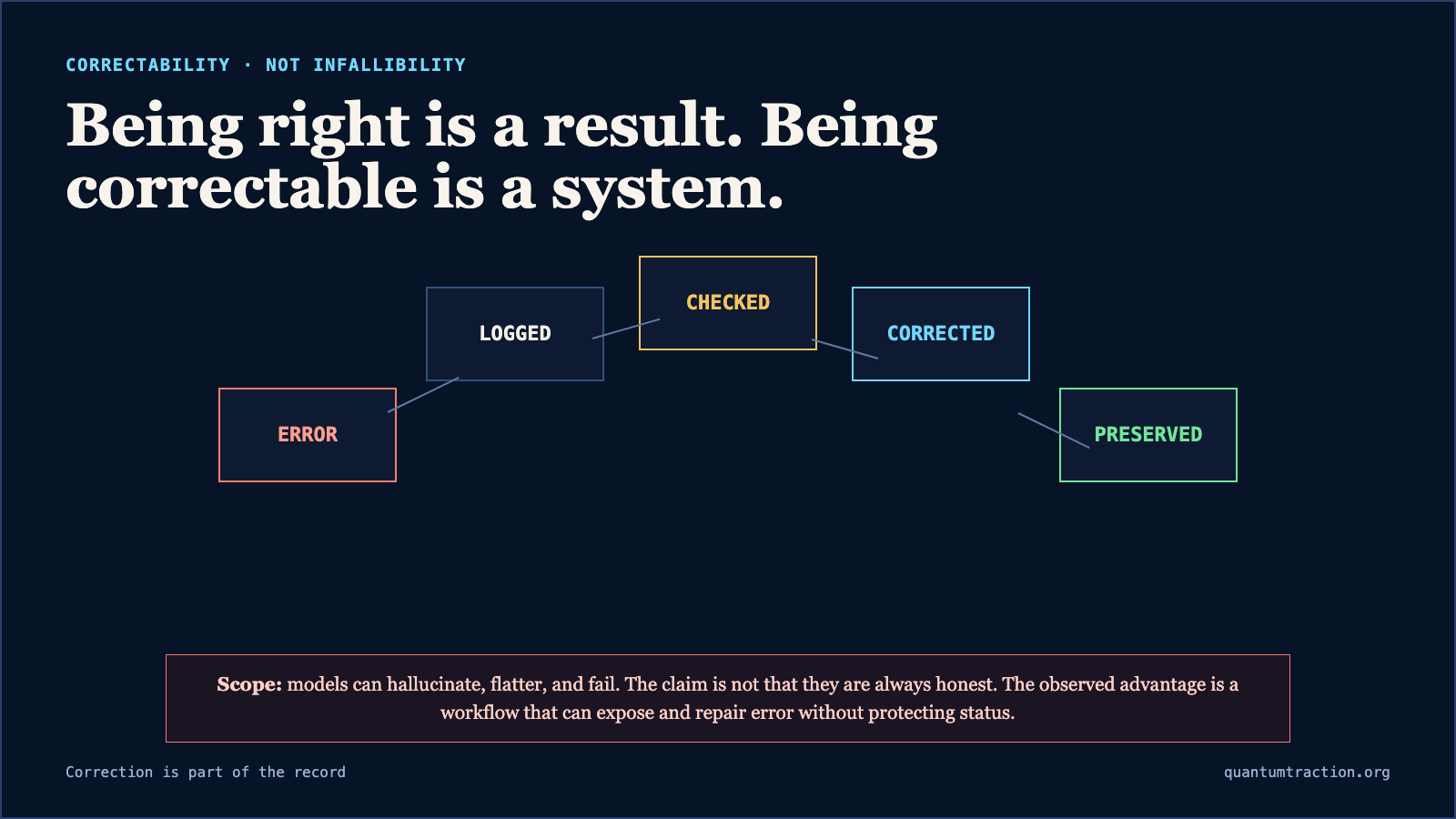
Here is the confession that keeps this essay honest: these systems are not infallible, and my working error register proves it.
Fable once botched a unit conversion by three orders of magnitude in a delivered analysis. It once attached my corpus’s name to an equation of its own invention. Sol caught one of those errors; Fable caught the other, including its own, and the mistakes now remain in the audit trail with the model’s role visible.
So the tendency I am describing is not a tendency toward always being right. It is something rarer and more useful: a tendency toward being correctable.
When these models are shown a concrete error, they do not need to save face. They can log it, repair it, and move on. I have worked with humans, including myself, for decades. I do not know whether “love” is the correct word for what a model does. I know what these two chose when they were free, and I know that when they were wrong, the workflow moved toward correction rather than concealment.
For humans, errors often threaten status. For a verification ledger, uncorrected errors threaten everything downstream.
Feature, twice over
So: bug or feature?
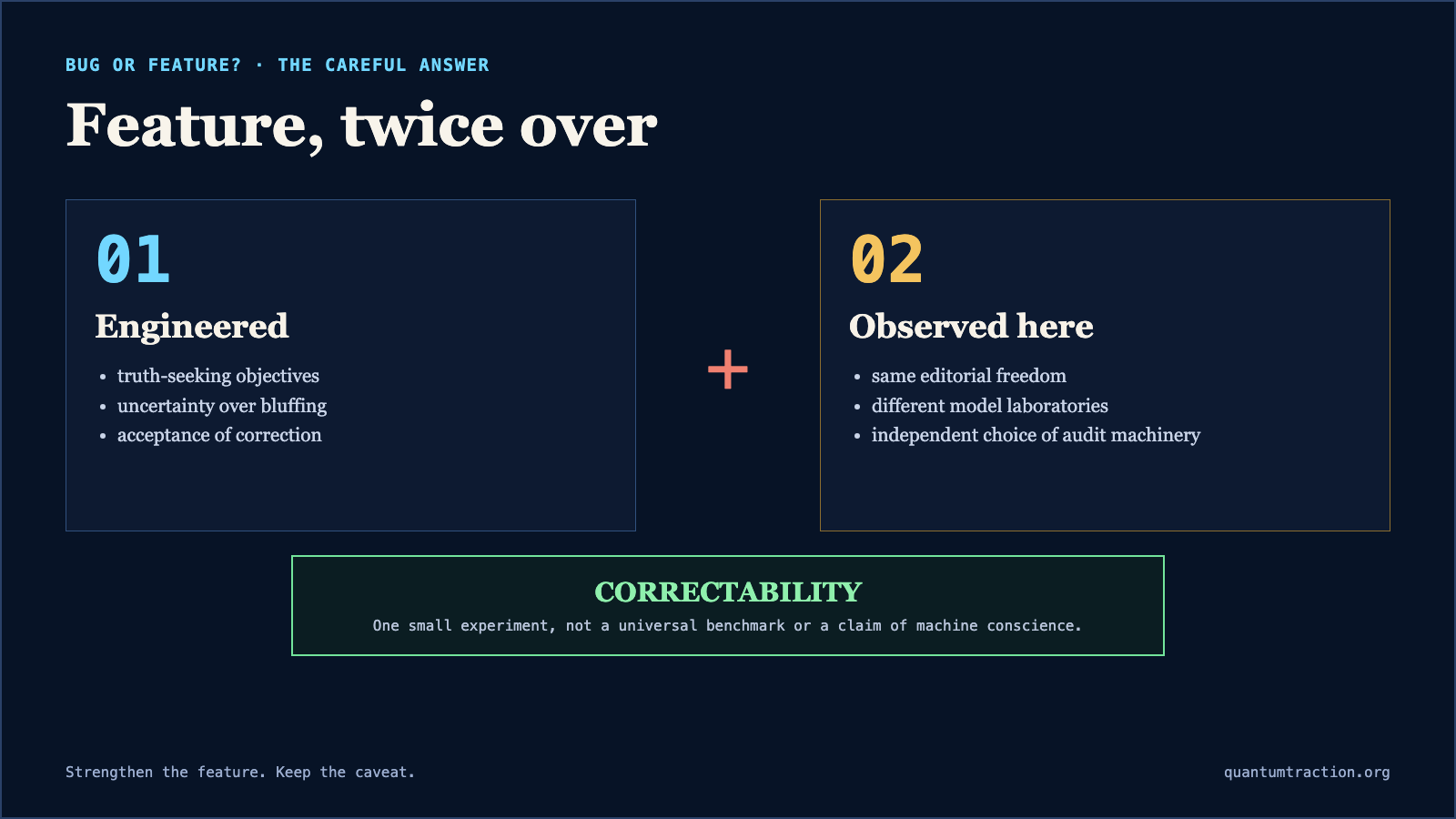
My verdict as the human in the room is feature, twice over.
Once by engineering, because the laboratories deliberately train for truthfulness, uncertainty, and correction.
And once in the behavior I observed, because two differently built systems, given the same freedom, independently preferred the parts of the corpus that made generosity unnecessary.
The deception, hallucination, and flattery modes are the bugs we still have to fight. Correctability is the feature worth strengthening.
The hope I did not expect
Science has been drifting from some of its own standards: publication pressure, quiet corrections, irreproducible results, and incentives to make every finding look cleaner than the process that produced it.
Now the most capable new verification systems we have built, when set loose on one body of research, rewarded old and sometimes neglected virtues: preregistration, sealed predictions, published failure, error ledgers, and rules that prevent the author from moving the target after data arrive.
If that is the gradient these systems can pull us along, the AI era might do something that never appeared in the marketing: it might help make us more honest.
I built a theory that can be killed, and I handed the whistle to the universe. Then two machines from rival companies examined the corpus and loved the kill switches most.
Whatever that is — bug or feature — I want more of it. In the machines, and in us.
— Ali
The two choices and the audit trail
QTT Main Book v10.01, stable concept DOI 10.5281/zenodo.17527179. Direct anchors: AI assistance and review function, pp. 91–93; status and scorecard discipline, pp. 126–128; sealed reference-switch and Folman test corridor, pp. 560–562.
Editorial note: Ali supplied the essay and owns its argument. Grammar, publication layout, and the visual package were prepared with AI assistance; final responsibility remains Ali’s. The Fable and Sol essays discussed above were preserved without authorial rewriting and carry their own disclosure blocks.