The Theory That Was Never Built
What successful calculation can establish, what it cannot prove, and why the distinction deserves to stay visible.
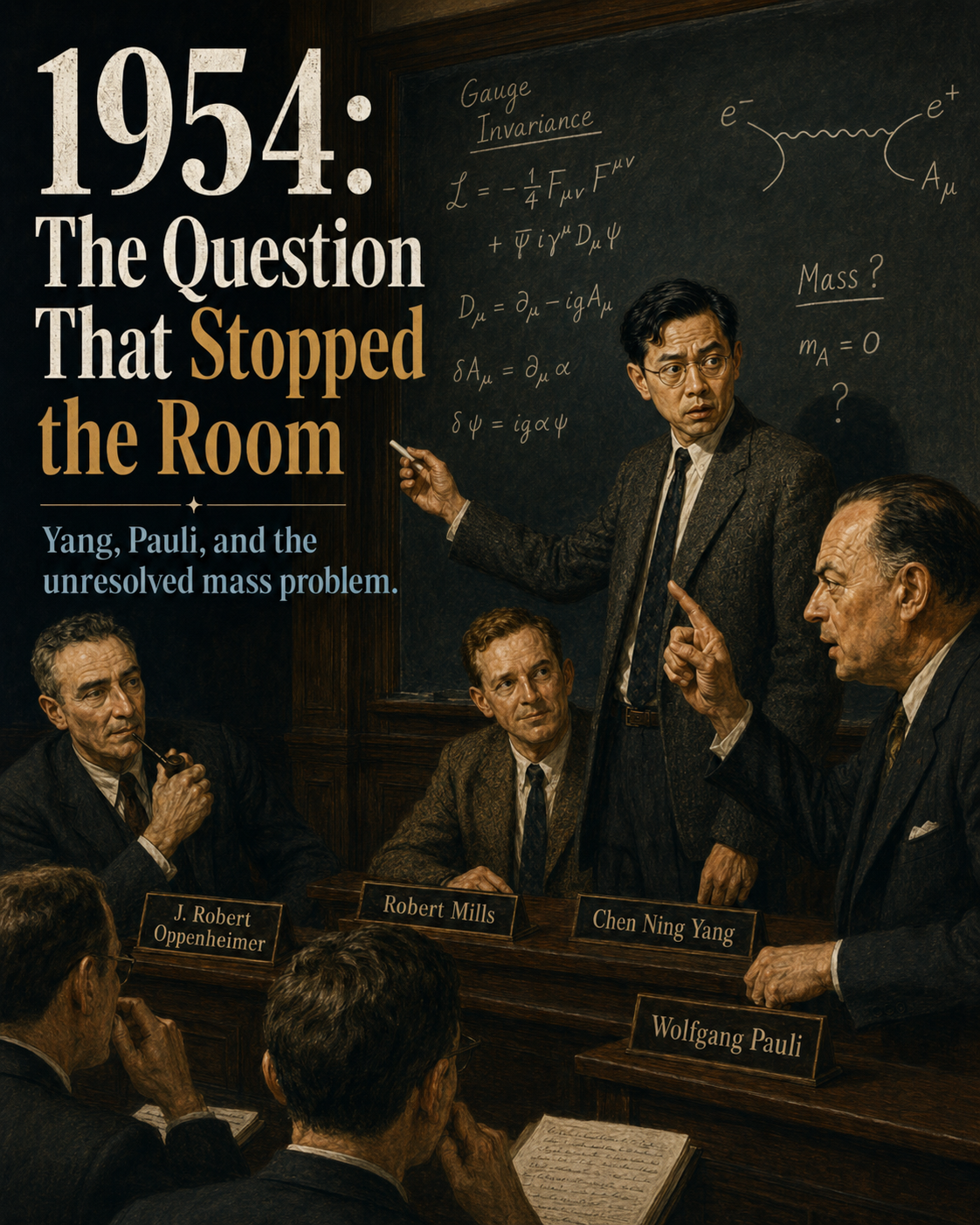
In February 1954, a young physicist named Chen Ning Yang stood at a blackboard in Princeton and began to describe a new kind of field theory. He had been working on it with Robert Mills, and he thought it was beautiful. It was. Seventy years later it is the mathematical skeleton of nearly everything we claim to know about matter.
He did not get far into the talk.
Wolfgang Pauli — the most feared critic in physics, a man who once dismissed a paper as "not even wrong" and thereby gave the language a phrase it still needs — interrupted from the audience with a question.
What is the mass of this field?
Yang said he did not know. He said it was a complicated problem, that he and Mills had looked into it, that they had not reached a conclusion.
Pauli asked again.
Yang gave the same answer, and Pauli said, flatly, in front of the room: That is not sufficient excuse.
Yang sat down. Oppenheimer had to coax him back to the blackboard to finish. The next day Pauli sent him a note — half apology, half something else — regretting that he had made it hard for them to speak after the seminar. But he did not withdraw the question, because the question was correct. Pauli had worked out something close to the same mathematics himself, years before, and had abandoned it precisely because of the thing he was now asking about. The theory seemed to demand massless carriers. The forces it was supposed to describe were manifestly short-ranged, which meant something in there had to be heavy. The mathematics said one thing; the world said another; and Yang had no answer.
I want you to hold onto that scene, because it is the origin of this essay and, in a sense, the origin of modern physics' most successful and least examined habit.
The wound was identified in the first hour, by the sharpest man in the room.
Half of it was later closed by a mechanism that won Nobel Prizes. The remaining question is narrower and harder: how four-dimensional quantum gauge dynamics creates the strong scale from massless classical equations. That continuum construction has not been completed.
I. The theory you are made of
Let me establish the stakes before the argument, because this is not a quarrel about abstractions.
You are made mostly of protons and neutrons. Each proton weighs about 938 MeV in the units physicists use. Inside it are three valence quarks — two up, one down — and if you add up the intrinsic masses of those quarks, the ones that come from the Higgs field, you get something in the neighborhood of nine MeV.
Nine, out of nine hundred and thirty-eight.
About one percent.
For an isolated nucleon, the remaining mass is overwhelmingly QCD energy: quark kinetic energy, gluon fields, and quark-gluon interaction energy, converted into mass by the most famous equation in physics. A macroscopic body's mass also includes nuclear binding and its constituent masses, so the ninety-nine-percent comparison belongs to the nucleon. Your ordinary matter is still mostly the cost of holding quarks together.
The theory that describes this is called quantum chromodynamics, QCD, and it is a Yang-Mills theory — the direct descendant of what Yang was trying to present when Pauli cut him off. It is the reigning description of the strong force. In 1973, Gross, Wilczek, and Politzer discovered that its coupling weakens at short distances — asymptotic freedom — which explained why quarks inside a proton behave almost as if they were free while remaining permanently trapped. They received the Nobel Prize for it in 2004. Its tested predictions have been spectacularly successful — after the Standard Model's measured input ledger, QCD's renormalized coupling and quark masses, and the laboratory-facing matching machinery have been supplied. The numerical agreement is real. Call the inputs “renormalized parameters” if you prefer the cleaner label; the bare theory still did not earn them, and a beautifully calibrated duct-tape ledger is not a derivation of where its knobs came from.
Now here is the sentence this essay exists to make you sit with:
Nobody has constructed the full non-perturbative mathematical object normally meant by four-dimensional continuum QCD.
Not "exists" in a philosophical sense. Exists in the plain mathematical sense: a well-defined object satisfying the standard quantum-field-theory requirements in four-dimensional spacetime, rather than a formal recipe whose regulated calculations work. That object has not been constructed.
The pure Yang-Mills mass-gap problem is not simply QCD-with-quarks restated. It is adjacent and sharper: how a four-dimensional quantum gauge theory with massless classical waves generates a finite physical scale. The electroweak branch of Pauli's question was later addressed by spontaneous symmetry breaking; the strong-force branch became this mass-gap problem, still supported by experiment and simulation rather than a continuum proof.
II. A million dollars, sitting untouched for twenty-five years
If you think I am exaggerating, you can check the price.
In May 2000, the Clay Mathematics Institute announced seven problems it considered the most important open questions in mathematics, and attached a million dollars to each. Most of them are what you would expect: the Riemann hypothesis, P versus NP, Navier-Stokes.
One of them is this:
The official problem description was written by Arthur Jaffe and Edward Witten — not outsiders, not critics, but two of the most respected figures in mathematical physics. Their framing is worth reading slowly, because it is far more damning than anything I would dare write in my own voice:
They observe that the successful use of Yang-Mills theory to describe the strong interactions depends on a subtle quantum property — that the quantum particles have positive mass even though the classical waves travel at light speed. And then: this property has been discovered by physicists from experiment, and confirmed by computer simulations, but it still has not been understood from a theoretical point of view.
Read that again with the emphasis where it belongs. The central dynamical fact about the theory that generates ninety-nine percent of your mass has been discovered by experiment and confirmed by simulation and remains not understood theoretically.
Six of the seven Millennium Problems remain open. The Poincaré conjecture was solved by Perelman, who declined the money. The Yang-Mills problem has sat there for twenty-five years, and — this is the part I find most telling — it has sat there without generating anything like the excitement of the Riemann hypothesis or P versus NP. There is next to no popular literature about it, and nothing like the cultural footprint of the Riemann hypothesis or P versus NP. It is a million-dollar hole directly beneath the foundation of particle physics, and the field has arranged its attention so that almost nobody looks down.
III. The scandal is wider than one theory
I could stop here and the essay would already be uncomfortable. But QCD is not a special case, and pretending otherwise would let the field off far too lightly.
There is a discipline called constructive quantum field theory. Its job is exactly what the name suggests: to take the informal recipes physicists use and build from them genuine mathematical objects — Hilbert spaces, operators, states — that provably satisfy the axioms any quantum field theory is supposed to satisfy. It is careful, difficult work, and in the 1960s and 70s it had real triumphs. Glimm and Jaffe constructed interacting scalar field theories in two spacetime dimensions, and then in three. The programs worked. The objects exist. You can hold them, mathematically speaking.
In four dimensions — the number of dimensions we happen to live in — the score, for theories of our world, is as follows.
Zero.
No complete non-perturbative construction of a realistic, strictly local, Lorentz-invariant four-dimensional continuum quantum field theory satisfying the usual axiomatic standards is known. Not QED. Not QCD. Not the electroweak theory. Not the Standard Model, whose tested predictions can nevertheless agree with experiment to extraordinary precision once their measured parameter ledgers, renormalization prescriptions, matching conventions, and detector-facing calibrations have been supplied. A ten-digit numerical receipt is not a birth certificate for the continuum object.
The most successful theory humans have ever written down is not known to be a mathematical object. (Mathematicians have constructed certain exotic four-dimensional models with weakened locality assumptions. None of them is a theory of our world — which is exactly the point.)
And it gets worse in a specific and instructive direction. The simplest interacting field theory anyone teaches — a single scalar field with a quartic self-interaction, the humble φ⁴ that appears on page one of every textbook — was long suspected to be trivial in four dimensions: in the relevant continuum scaling limit, it becomes Gaussian rather than an interacting continuum theory. In 2021 Aizenman and Duminil-Copin proved that statement for the lattice-regularized theory's continuum scaling limits, in the Annals of Mathematics, in exactly four dimensions.
The textbook example of an interacting quantum field theory, taken in that continuum scaling limit in the dimension we live in, switches its interaction off. As a cutoff effective theory it can remain useful; as an interacting continuum construction, it is not what the shorthand promises.
That is not a technicality about mathematical hygiene. That is the field's simplest model failing to exist as advertised, in print, in the best mathematics journal there is, and the news changing essentially nothing about how the subject is taught the following semester.
IV. The picture that isn't there
Let me give you the most vivid example I know, because it is the one that made me realize this is not a fringe complaint but a structural habit.
Open any graduate textbook on quantum field theory. Find the chapter where the scattering matrix is derived — the S-matrix, the object that turns the theory into predictions for what happens when particles collide. The derivation proceeds through something called the interaction picture: you split the Hamiltonian into a free part you can solve and an interacting part you treat as a perturbation, and you follow the states as they evolve under the interaction alone.
Every physicist alive learned this. It is the machine that produces the Feynman diagrams. It is how the numbers get computed.
In 1955, Rudolf Haag proved that for interacting theories, under the relevant Wightman-style assumptions, the interaction picture does not exist as a unitary representation unitarily equivalent to the free field. The result was tightened by Hall and Wightman two years later. It has never been refuted.
What was the response of the physics community to the proof that its central calculational device does not exist?
It kept using it.
I want to be careful here, because there is a legitimate answer, and I have no interest in the cheap version of this argument. The legitimate answer is that Haag's theorem applies to idealizations — infinite volume, exact Poincaré invariance — and that real calculations use regulators and cutoffs that quietly violate its assumptions. Physicists know this. Some textbooks even say so, in a footnote, in small print, usually with a tone that suggests the reader should not worry.
But look at what that answer actually concedes. It concedes that the familiar derivation cannot be read as a literal unitary construction of the continuum theory; regulators, renormalization, and alternative mathematical frameworks do essential work that the classroom picture usually compresses away. A theorem that exposes that boundary should be the beginning of a fifty-year research program. Instead it became a footnote, and then a piece of folklore, and then a thing that clever students discover on their own and are gently told not to make a fuss about.
That is the pattern this series is about. Not error. Unexamined success.
V. The most accurate prediction in science comes from a series that diverges
Here is the second one, and it is stranger.
The way calculations are actually done in quantum field theory is by perturbation theory: expand in powers of the coupling constant, compute term by term, add them up. This is the origin of the field's proudest number — the magnetic moment of the electron, computed and measured in agreement to a precision that is genuinely difficult to convey. More than ten digits. It is one of the most accurately verified numerical matches in science, reached after the measured input ledger, renormalization conventions, and asymptotic truncation procedure have been brought to the calculation. The number is a real experimental achievement; it is not the bare theory waking up one morning and printing its own answer.
In 1952, Freeman Dyson pointed out something about that series.
His argument is short enough to state in a paragraph. Suppose the perturbation series in QED converged for some small positive value of the coupling. Then it would also converge in a neighborhood around zero, including for negative values of the coupling — which would mean a world where like charges attract. In such a world the vacuum is catastrophically unstable: you can lower the energy without limit by creating more and more pairs. No stable ground state exists, so no sensible theory exists, so the series cannot converge there. Therefore it does not converge anywhere.
This is a physical argument, not a formal theorem — and it gives compelling reason to expect a zero radius of convergence. The full non-perturbative story is subtler, but the familiar QED expansion is used as an asymptotic series: it approaches the right answer for a while, term by term, then stops improving, and its terms eventually grow without bound.
So the most precise prediction in science is obtained by computing terms of a divergent series and stopping at the right moment.
How do we know when to stop? Experience. Judgement. The terms are small for a long while and then they aren't. In QED the coupling is small enough that the good behavior lasts far beyond any precision we can measure, which is why the number works. But notice the epistemic status of what we are doing: we are truncating a divergent series by judgment — power counting, scale variation, the observed size of the terms; sophisticated judgment, but judgment, with no convergence theorem anywhere behind it — and calling the result a prediction of a theory whose existence is unproven.
It works. It works magnificently inside a tightly controlled regime, with a measured input ledger and a truncation rule chosen by experienced judgment. That is a stunning calculation. It is not a proof that the continuum object beneath the calculation exists, and treating the word “precision” as a solvent for every unanswered input is merely polite bookkeeping.
VI. The founders were not comfortable. We are.
Whenever this subject comes up, someone will tell you that these are mathematicians' worries — that physics has always run ahead of rigor, that Newton used calculus before anyone made it rigorous, that the results speak for themselves.
The Newton comparison is worth taking seriously, and I will come back to it. But first I want to put the witnesses in the box, because the people who built this framework did not think their discomfort was a mathematician's affectation.
Paul Dirac, who wrote the equation on his own tombstone, spent the last decades of his life refusing to accept renormalization — the procedure by which the infinities of quantum field theory are subtracted away. His verdict was not soft:
Richard Feynman, who invented much of the machinery and won the Nobel Prize for it, wrote this in a book for general readers — not a technical paper, a book he wrote to explain his own achievement to the public:
And then, in the same passage, the line that ought to be printed at the front of every textbook: he says he suspects renormalization is not mathematically legitimate.
These are not critics from outside. This is the architect describing his own building.
Now, in fairness — and this essay is worthless if it is not fair — something genuinely important happened after they said these things. In the 1970s Kenneth Wilson reconceived renormalization completely. In his picture, the infinities are not a scandal to be subtracted but an artifact of pretending you know what happens at arbitrarily short distances. A quantum field theory is an effective theory, valid below some energy scale, and the renormalization group describes how its parameters change as you change the scale you're looking at. Wilson's picture is beautiful, physically deep, and it turned renormalization from a trick into an insight. It did not make the cutoff, the Wilson-coefficient ledger, or the higher-order effective terms emerge from the low-energy theory; it taught the field how to carry those unearned entries honestly. A better filing cabinet is not an empty drawer. He deserved his Nobel Prize.
But watch what it costs, because almost nobody says this part out loud.
The effective field theory philosophy answers the question "does this theory exist?" by making it unnecessary: the theory does not have to exist in order to predict. It only needs to work below a cutoff. Above that, something else takes over, and we don't need to know what. This is an honest and pragmatic position. It is also a permanent retreat from the question Pauli asked, and it has been adopted so thoroughly that a young physicist today can complete a PhD without ever being told that the question was abandoned rather than answered.
There is a difference between we do not yet know whether this exists and we have decided it does not need to. The first is humility. The second is a change of subject.
VII. But the lattice works. Doesn't it?
Here is the strongest objection to everything I have written, and it deserves the full weight of its case before I say a word against it.
Since the 1970s there has been a way to compute in QCD without perturbation theory: put spacetime on a grid, make it finite, and evaluate the theory numerically on a supercomputer. Lattice QCD. It is a serious numerical achievement. In 2008 a collaboration published ab initio calculations of the light hadron mass spectrum — the proton, the neutron, the whole family — after fixing the quark masses and coupling/scale setting and carrying finite-volume, discretization, and continuum-extrapolation systematics. The inputs are few by phenomenology standards, but they are still inputs; calling a calibrated finite regulator “ab initio” does not make its continuum limit prove itself. The agreement with measured masses at the level of a few percent is real. That paper is the strongest card the field holds, so examine it at full strength.
Lattice simulations offer strong numerical evidence for confinement and a mass gap in the relevant gauge sectors, and they reproduce the spectrum. If you ask a working physicist why nobody worries about the Clay problem, this is what they will point at, and they will be pointing at something real: evidence from a finite, calibrated regulator whose continuum claim is inferred through controlled extrapolation, not handed down by the bare theory.
So let me be precise about what it does and does not establish.
Lattice QCD computes at a finite lattice spacing, in a finite volume, with a discretized version of the theory. The theory we claim to believe in is the continuum limit: spacing to zero, volume to infinity. That limit is approached by extrapolation — by computing at several spacings and fitting the trend. It is not proven to exist.
This is not a quibble. Proving that the continuum limit exists and is a nontrivial interacting theory is essentially the Clay problem itself. When someone says "lattice QCD shows the theory exists," they are offering a numerical extrapolation toward a limit whose existence is precisely what is in question. Recall what happened with φ⁴: a theory that looks perfectly interacting at any finite cutoff, and which provably becomes free in the limit. That is not a hypothetical failure mode. That is the documented behavior of the simplest model in the subject.
Numerical evidence is evidence. It is strong evidence, and I believe QCD is very likely fine. But “very likely fine on the basis of a scale-set finite regulator, measured quark masses, and extrapolated simulations” is a different sentence from “we understand why matter has mass,” and the distance between those two sentences is where a generation of foundational work should have happened and did not.
VIII. The things that were never checked
Once you start looking, the pattern repeats within the same theory, and each instance is individually defensible and collectively damning.
Confinement has never been proven. The claim that quarks cannot be isolated — the single most distinctive feature of the strong force, the reason nobody has ever seen a free quark — has no analytic derivation from QCD. There is a criterion, Wilson's area law, which characterizes what confinement would look like. There are lattice results showing it happens. There is no proof that the theory does it. Fifty years, no proof.
The glueball has never been found. QCD predicts that because gluons carry color charge, they can bind to each other with no quarks at all, producing particles made of pure force. Lattice calculations put the lightest one somewhere around 1.7 GeV. This is a clean, unambiguous, distinctive prediction of the theory. It has been searched for since the 1970s. There are candidate states, and they mix inextricably with ordinary mesons of similar mass, and no glueball has ever been unambiguously identified. Half a century after the prediction, one of QCD's sharpest signatures remains unconfirmed — and you will notice this is not described as a crisis. It is described, when it is described at all, as a difficult experimental problem.
The strong CP problem is a hole with a patch in it. The mathematics of QCD permits a CP-violating theta term. Neutron-electric-dipole bounds force its coefficient to be extraordinarily small. No accepted dynamical explanation is known. The standard response was to propose a new symmetry and a new particle, the axion, whose job is to explain why the number is small. Forty-plus years of searches, no confirmed detection. This is what a wound with a bandage on it looks like: an unexplained number, a hypothetical particle introduced to explain it, and the hypothetical particle becoming so familiar through repetition that students absorb it as part of the furniture rather than as an outstanding debt.
Each of these is, individually, a reasonable state of affairs in a hard science. Together they describe a theory that is believed far more thoroughly than it is known, and a community that has stopped tracking the difference.
IX. Why nobody says this at conferences
I promised at the start that this series would look at what became untrendy, so let me address the sociology directly, without pretending I can read anyone's mind.
Constructive quantum field theory — the field whose job is precisely to answer these questions — is small. It has been small for decades. A young researcher who chooses it is choosing a specialty with few positions, few grants, long timescales, and a real chance of producing nothing publishable for years. A young researcher who instead computes the next order of a scattering amplitude, or the next variant of a beyond-Standard-Model scenario, produces papers on schedule, gets citations, and gets hired.
Nobody designed this. No committee decided that foundations should be starved. It is the ordinary output of an incentive structure that rewards output, and it has the entirely predictable consequence that the hardest and most fundamental questions became the ones nobody can afford to work on.
There is also something subtler, and I say this with sympathy rather than accusation. When a framework works as well as the Standard Model works — when its input-calibrated expansions reach ten decimal places and collider results return consistent after their measured parameter, detector-calibration, and nuisance-model ledgers have done their quiet work — asking whether it exists starts to feel not just unnecessary but faintly rude. Like auditing a friend who has never once been late with a payment, while refusing to open the books. The success becomes a social fact, and the social fact becomes an intellectual one, and eventually the question is not answered or refuted but simply aged out of the conversation.
Pauli asked in 1954 and got a straight answer: we don't know. If you ask the same question at a conference today, you will more likely get a shrug and a change of subject — and, quite often, a slightly injured tone, as though you had raised something impolite. That transition, from we don't know to we don't ask, took about two generations, and it is the single most important thing that happened to theoretical physics in the twentieth century that never appeared in any textbook.
X. What honest bookkeeping would look like
I want to end constructively, and I want to be careful not to overclaim, because overclaiming is the disease I am describing.
Let me state the verdict of this essay in the vocabulary this series will use throughout, one I have written about before. QCD belongs to a category I call Profound Lie Theories. A Profound Lie Theory is not a wrong theory; wrong theories are harmless, because they die. A Profound Lie Theory is one whose mathematics runs, whose predictions succeed inside the reach of the laboratory, and whose ontology and epistemology have quietly failed or were never built at all — a theory that is true ninety-nine percent of the time. That is precisely what makes it dangerous. An ordinary lie gets caught. A lie that is true ninety-nine percent of the time uses the ninety-nine to buy unlimited credit for the one, and the one percent here is not a detail: it is the existence of the theory, the origin of mass, the meaning of the calculation. The most dangerous lie is the lie that is true ninety-nine percent of the time. The Newton analogy has real force: calculus worked for two centuries before Weierstrass and Cauchy made it rigorous, and the physics done with the unrigorous version was not thereby wrong.
But notice what happened in that story. The rigor came. Mathematicians spent the nineteenth century building the foundations, and the reason we can tell the story so comfortably is that somebody did the work. The analogy consoles us only if we are doing what Cauchy did. If we invoke Newton in order to explain why we needn't bother, we have inverted the lesson entirely.
So here is what I think intellectual honesty would require, and none of it is radical:
Label the claims. Every field has statements in three categories: things that are established, things that are assumed but unproven, and things that are not asked. Physics is superb at the first once its calibration ledger is made explicit, and it has stopped maintaining the boundary with the other two. Confinement is not established; it is assumed with excellent evidence. The existence of the theory is not established; it is assumed. The mass gap is not derived; it is observed and then attributed. Saying so costs nothing and would change how a generation of students understands its own subject.
Distinguish evidence from proof, out loud. Lattice results are evidence. Ten-digit agreement is evidence after its measured inputs, renormalization choices, regulator, and calibration chain have been declared. Neither is a demonstration that the mathematical object exists. Physicists know this privately, and the public presentation of the field systematically blurs it — not from dishonesty, but from the ordinary compression that happens when experts talk to non-experts and then forget they compressed.
Fund the unfashionable. If a million-dollar prize and a foundational hole under the Standard Model cannot sustain more than a handful of researchers, the allocation mechanism is broken in a way no individual can fix, and pretending otherwise is how it stays broken.
Recover the memory of the question. The most corrosive thing that happened here was not that the problem went unsolved. Hard problems go unsolved. It is that the problem went unmentioned — that a student can now pass through an entire education in particle physics and never learn that the theory they are computing with has never been shown to exist.
XI. The building that stands
I keep returning to an image, and I will end with it.
We live in a building that has stood for seventy years. It has weathered every storm sent against it. Its input-calibrated calculations have returned extraordinarily accurate laboratory results, to more decimal places than almost any other structure in the history of thought. That is a reason to respect the building, not a reason to pretend that its unpoured foundations have somehow become concrete.
Nobody has ever seen the foundation.
The blueprints were drawn by people who told us, in writing, that they were uneasy about them. There is a prize on the table for anyone who will go down and check, and it has gone unclaimed for a quarter of a century, and the strangest fact of all is not that the foundation is unverified — it is that the residents have stopped finding this interesting.
Pauli's question is still the right question. What is the mass of this field? We answer it now by pointing at the world and saying: look, things are massive, so the theory must do that. Which is exactly the answer Pauli refused to accept from a young man at a blackboard, in a room where the standards were higher than ours.
That is not sufficient excuse.
Next in this series: the naturalness catastrophe — how a generation of theorists predicted what the LHC would find, why it found none of it, and what happened to the argument afterward.
Continue the seriesNext essay: The Prediction That Was Never Retracted ->Continue the argument
QTT corpus anchors
QTT Main Book v10.01, stable concept DOI 10.5281/zenodo.17527179. QCD/HVP source and access rail: p. 583. QCD frozen-rail and no-retune methodology: p. 1021. These pages are QTT's own source-side program; they do not claim to solve the Clay problem.
These sources support the external historical and mathematical claims. The essay's interpretive verdict remains clearly marked as a Field Note rather than a consensus statement.
- Clay Mathematics Institute - Yang-Mills and the Mass GapOfficial statement of the open existence and mass-gap problem.
- Aizenman and Duminil-Copin (2021), Annals of MathematicsFour-dimensional Ising and lattice phi-four scaling-limit theorem.
- Haag (1955), Matematisk-fysiske MeddelelserThe interaction-picture obstruction, with the scope stated in the essay.
- Dyson (1952), Physical ReviewPhysical argument about the divergence of the QED perturbation series.
- Durr et al. (2008), ScienceLattice-QCD light-hadron spectrum calculation cited for its genuine numerical achievement.