The Equation Nobody Was Allowed to Doubt
What general relativity proves about its own boundary, what galaxies force us to inventory, and which parts of the QTT alternative are closed or still open.
On the place where general relativity hands in its own resignation letter, the galaxies that refused to obey it, and the small number of people who said so out loud.
I ended Essay 1 with the turtle, and I want to start this one with the same animal, because the turtle has a second job I did not give it credit for.
The turtle is not only about foundations. It is about what happens to a discipline when one of its towers becomes too beautiful to question. You do not stop asking what holds the tower up because you are stupid. You stop asking because the tower has been right about so many things, for so long, that the question begins to sound rude.
General relativity is the most beautiful tower we have. It is also the clearest case I know of a theory that has told us, in writing, in its own mathematics, where its classical description becomes incomplete - and then watched that warning spend sixty years being treated as somebody else's future problem.
i. The theory that proved its own breakdown
Here is the part that still astonishes me, and I think it should astonish anyone who sits with it honestly.
Nobody had to catch classical general relativity reaching a boundary in gravitational collapse. General relativity proved the boundary from inside its own mathematics.
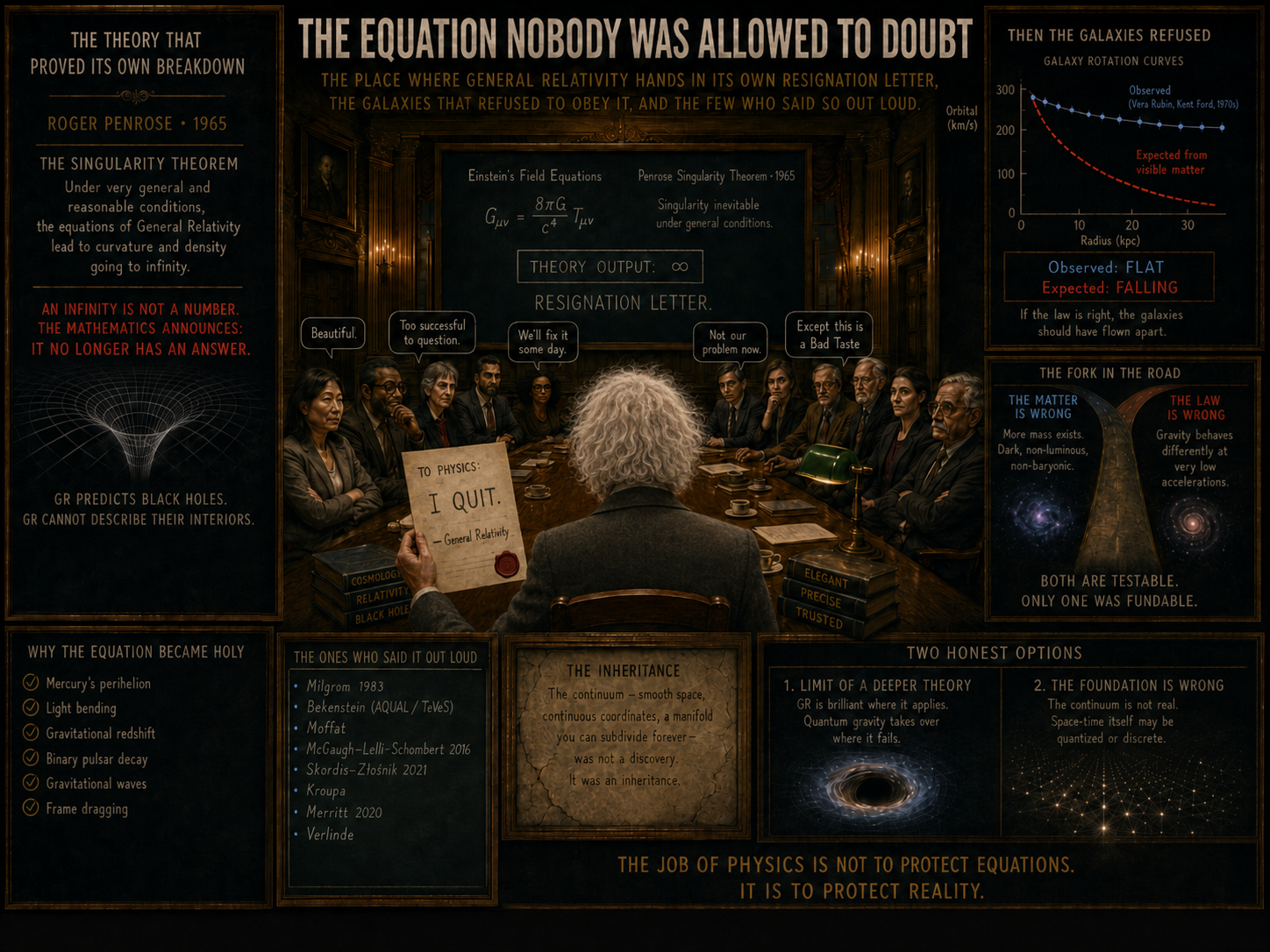
In 1965 Roger Penrose showed - not as a special-case calculation with convenient spherical symmetry, but as a theorem - that a spacetime containing a trapped surface cannot remain future null-geodesically complete when the theorem's causal and energy conditions hold. In plain language: at least one future-directed lightlike path cannot be continued through the classical spacetime. That is the rigorous result. It is stronger than a coordinate accident and more precise than saying that the theorem itself proves a material point of infinite density.
The distinction matters. Specific classical black-hole solutions do contain divergent curvature invariants, and the physical expectation is that new physics is required in the high-curvature interior. But Penrose's theorem is a theorem of geodesic incompleteness under printed assumptions; it does not, by itself, prove that every curvature scalar diverges in every admissible spacetime. The strongest honest statement is already severe enough: the classical spacetime description cannot be complete in the theorem's domain.
Read what that means without the usual reverence. A divergent invariant is not a very large laboratory number waiting for a better instrument, and geodesic incompleteness is not a hidden object we can photograph. Both are warnings that the classical description has reached a domain boundary. When a continuum extrapolation produces an unbounded quantity, it has not supplied a microscopic ontology. It has handed in a resignation letter for that extrapolation.
Penrose received the 2020 Nobel Prize for showing that black-hole formation is a robust prediction of general relativity. Both readings belong on the same line: the theory robustly predicts the collapse regime, and its classical spacetime is not complete through that regime. The first is usually said at full volume. The second is often handed to an unspecified future theory of quantum gravity.
One correction is essential: an event horizon is not the singularity. A horizon is a causal boundary in the classical geometry; the incompleteness lies deeper in the extrapolated spacetime. Confusing the two would let a knowledgeable reader dismiss the whole argument for the wrong reason. The actual criticism survives intact: saying that quantum gravity will eventually resolve the interior is a research programme, not a completed solution. That promissory note has been rolled over for six decades, and the interest is now larger than the loan.
And notice the strange asymmetry in how we treat it. When a theory predicts infinity, there are two possible readings. One: the theory is incomplete and something else takes over. Two: the theory is telling us that its own basic objects — smooth space, continuous coordinates, a manifold you can subdivide forever — were never real to begin with. The field almost universally chose the first reading. I want to be precise about why that choice was not obviously correct: the second reading requires giving up the continuum, and the continuum was not a discovery. It was an inheritance.
ii. Then the galaxies refused
The second stress point did not come from inside the mathematics. It came from the sky, and it came with error bars.
In 1933 Fritz Zwicky looked at the Coma cluster and found that the galaxies were moving far too fast for the visible mass to hold them together. He proposed dunkle Materie — dark matter — and was largely ignored for forty years.
Then in the 1970s Vera Rubin, Kent Ford and collaborators made the measurements that could not be ignored. Their extended rotation curves traced orbital speeds farther into spiral galaxies. If the visible baryonic mass were most of the gravitating mass and were centrally concentrated, the outer speed should decline approximately as the inverse square root of radius. Instead, many disk-galaxy curves remain roughly flat well beyond the bright central regions.
This is not a marginal anomaly. Across many spiral and disk galaxies, the dynamical mass inferred under Newtonian gravity substantially exceeds the directly inventoried baryonic mass. The detailed size of the discrepancy depends on radius, gas, distance, inclination and stellar mass-to-light modelling, so "every galaxy" and one universal factor would be careless. The robust fact is enough: visible matter plus the unmodified low-acceleration law does not reproduce the observed outer kinematics.
So a genuine fork appeared in the road, and it is worth naming both branches precisely, because the way the field walked one of them is the actual subject of this essay.
Branch one: the matter is wrong. There is more mass than we can see — a new, non-luminous, non-baryonic component that clusters gravitationally and does almost nothing else.
Branch two: the law is wrong. Gravity itself does not behave the way Newton and Einstein wrote it down, once accelerations become extremely small.
Both branches are legitimate. Both are testable. The dark-matter branch became institutionally dominant and acquired far more experimental, simulation and cosmological infrastructure. Modified-gravity programmes remained much smaller. That asymmetry is historically visible; it is not, by itself, evidence that either branch is physically right.
iii. Why the equation became holy
I want to be careful here, because the lazy version of this story is a conspiracy story, and the conspiracy version is false and also boring.
Nobody suppressed anything. There were no meetings. What happened is stranger and more human: the equation had earned so much trust that doubting it stopped counting as physics and started counting as bad taste.
General relativity had, by the 1970s, an extraordinary record. Mercury's perihelion. Light bending. Gravitational redshift. Later: binary-pulsar decay, frame dragging, gravitational waves and horizon-scale imaging. Within current uncertainties and their declared domains, those tests strongly support the theory. But the accounting line must stay visible: the comparisons use measured masses and spins, source models, distances, calibration chains and astrophysical nuisance parameters. Those are often legitimate physical inputs, not arbitrary knobs. They still do not derive the matter inventory, the initial conditions or the continuum ontology from the field equation. A superb input-conditioned prediction is not the same thing as a source derivation.
But that record produced a professional reflex. When your best-tested equation disagrees with data, the cheap move — cheap in career terms, cheap in grant terms, cheap in seminar-room terms — is to add an ingredient to the input rather than question the equation. Adding invisible matter leaves the sacred object untouched. Questioning the field equations puts you in a category with a specific reputational smell.
So the field added the matter. And to be fair - genuinely fair, because this is where honest essays separate from polemics - the matter branch has done real work. Dark matter is not a patch invented once for rotation curves and then forgotten. A common non-baryonic component is used across cluster lensing, structure growth and the cosmic microwave background. The cosmological densities and primordial-spectrum parameters are fitted globally rather than invented separately for each galaxy, and the model survives many cross-checks. That is real empirical compression, achieved with a substantial input ledger and no direct source-level account of what the component is.
The Bullet Cluster, where the dominant lensing peaks are displaced from the X-ray gas after a cluster collision, is a hard constraint on pure baryons plus a simple modified force law. It is not a theorem against every relativistic modified-gravity theory, because such theories can carry additional fields or unseen components. It does make any alternative pay its full mass-and-lensing bill in public.
That is the honest scoreboard. Gravitational evidence for an unseen component is extensive. After five decades of increasingly sensitive searches, however, no non-gravitational particle detection has been accepted as dark matter. The latest LUX-ZEPLIN WIMP search, for example, reported no significant excess over expected backgrounds and set stronger exclusion limits. The ledger entry balances many books beautifully and has not yet identified itself at the detector door.
And one of the supposedly conversation-ending objections has been answered at least at the level of a concrete counterexample. In 2021 Constantinos Skordis and Tom Zlosnik published a relativistic theory producing MOND phenomenology while matching the observed CMB and linear matter power spectra, with the quadratic action free of ghost instabilities in the domain they analysed. That does not establish the theory as the correct cosmology or close its nonlinear and observational programme. It establishes something narrower and important: modified gravity is hopeless for cosmology is not a theorem.
iv. The people who said it out loud
In 1983 Mordehai Milgrom published three papers in the Astrophysical Journal proposing something far outside the dominant programme: below a fixed, tiny acceleration scale - around 10^-10 metres per second squared - the effective dynamical law changes.
He called it MOND, Modified Newtonian Dynamics. Its central new scale is a0, accompanied in concrete implementations by an interpolation law and by ordinary observational inputs. It linked several galactic regularities before they were built into halo-by-halo models, including the baryonic Tully-Fisher scaling and low-acceleration behaviour. But "from the light alone, with no fit" would overstate the case: practical rotation-curve analyses still use distance, inclination, gas data and stellar mass-to-light estimates. The real achievement is sharper and survives that correction: once the baryonic distribution and those declared inputs are supplied, MOND leaves much less per-galaxy freedom than a freely shaped halo fit.
MOND remained outside the dominant cosmological programme and was often treated as a specialist alternative rather than a co-equal research track. Milgrom kept publishing quantitative claims that could be checked against new data. That publication record, not a story about personal suffering that I cannot independently measure, is the receipt that belongs here.
He was not alone, and the others deserve their names in the record.
Jacob Bekenstein - already central to black-hole thermodynamics - took MOND seriously enough to give it a Lagrangian and then a relativistic body. With Milgrom he developed AQUAL in 1984, and in 2004 he published TeVeS, a metric-scalar-vector theory designed to reproduce MOND phenomenology while addressing lensing and relativistic tests. Its later viability is a separate question; its existence proves that the relativistic completion problem was a scientific construction problem, not a ban on asking.
John Moffat developed scalar-tensor-vector gravity, MOG/STVG, and applied it to galaxies, clusters and cosmology. The programme has parameters and open tests of its own; it belongs on the list because it turns disagreement into field equations rather than slogans.
Stacy McGaugh, Federico Lelli and James Schombert showed in 2016 that, across their sample of rotationally supported galaxies, observed radial acceleration follows a tight relation with the acceleration inferred from baryons. The Radial Acceleration Relation is an empirical regularity. It is not, by itself, a proof of MOND or a falsification of dark halos; baryonic feedback and galaxy-halo coupling can also be tested against it. Any viable account must nevertheless reproduce its small scatter and shape rather than simply admire the plot.
Constantinos Skordis and Tom Złośnik built the relativistic theory described above — the one that removed the objection everyone said was fatal. They did it at the Czech Academy of Sciences, on a question the mainstream had declared closed.
Pavel Kroupa has argued that satellite planes, dynamical-friction expectations and galaxy populations place stronger pressure on the standard cosmological model than is usually admitted. Those interpretations are disputed, and the frequency and persistence of satellite planes in simulations remain active research questions. The scientific point is the existence of a quantitative dispute, not a verdict by adjective.
Indranil Banik and Benoit Famaey work on quantitative tests of Milgromian dynamics, including galaxies, clusters and wide binaries. Some recent wide-binary claims are themselves contested because sample selection, multiplicity and velocity systematics matter. That is exactly why these questions need frozen analyses rather than applause lines.
Marcel Pawlowski has developed detailed analyses of satellite-plane structure around the Milky Way, Andromeda and nearby hosts. Thin and kinematically correlated configurations are observed; how unusual they are in the standard model depends on membership, statistics and simulation comparison. The problem is real, and so is the methodological argument about how to count it.
David Merritt did something different: as a professional dynamicist he wrote a book-length methodological analysis, A Philosophical Approach to MOND, comparing the predictive and auxiliary-hypothesis structure of the MOND and dark-matter research programmes. One can disagree with his Lakatosian verdict. One cannot honestly pretend that the methodological question was never formulated.
Erik Verlinde proposed an emergent-gravity programme in which gravity is not fundamental. Its quantitative reach and consistency remain debated, but it is an explicit attempt to make spacetime dynamics arise from deeper microscopic information rather than assume the metric as the final layer.
Philip Mannheim has pursued conformal gravity for decades. Claudia de Rham, Gregory Gabadadze, Andrew Tolley and collaborators developed nonlinear massive-gravity constructions that remove the Boulware-Deser ghost in their declared domains. These programmes show that the mathematical door was never literally locked. The distribution of attention and evidential burden was simply very unequal.
And on the black-hole side, Carlo Rovelli, Francesca Vidotto, Abhay Ashtekar and collaborators have developed Planck-star, bounce-interior and loop-quantum-geometry routes in which the classical singularity is replaced by quantum structure. These are research programmes, not experimentally closed interiors. They attack the same classical incompleteness from different mathematics.
I cannot turn invitations, referee tone or private career cost into a clean dataset, so I will not present them as one. The defensible claim is institutional and visible: these programmes received far less collective effort than particle dark matter and standard cosmology, while carrying a heavier burden of proof. The people named here kept alternative questions quantitative. That is what matters scientifically. Not that they must be right - we do not yet know who is right - but that the questions remained calculable when the room preferred them settled.
v. The older thread: when length itself stopped making sense
There is an even older seam of doubt, and it runs directly under relativity's foundations rather than out at the galactic edge.
In 1909 Paul Ehrenfest asked a devastatingly simple question about a rigidly rotating disk. The rim moves; by special relativity, lengths along the direction of motion contract; so the circumference should shrink. The radius is perpendicular to the motion, so it does not contract. But then the ratio of circumference to radius is no longer 2π — and a rigid, flat, Euclidean disk cannot exist.
That paradox is not a curiosity. It is one of the threads that sharpened the role of non-Euclidean spatial geometry for rotating observers. The mathematics is more settled than the dramatic version sometimes suggests: Born rigidity is highly restrictive, and the Herglotz-Noether theorem sharply limits rotational Born-rigid motion. A disk cannot be spun up from rest as one globally Born-rigid body. Interpretations of circumference, synchronization and spatial geometry vary with the operational frame, but the kinematic constraint is not an unsolved paradox.
This is not ancient history with no modern custodians. Oyvind Gron has written detailed analyses of the rotating-disk problem, and Matteo Luca Ruggiero and Guido Rizzi assembled a standard volume on relativity in rotating frames. The continuing literature does not mean special relativity failed to solve its own kinematics. It means the word length is operational: one must state which observers, which simultaneity convention and which rigidity history define it.
I raise it because of what it reveals about the inherited picture. We often speak as if length were a primitive - something the world simply has, which theories then describe. The rotating disk was an early, vivid place where that language became observer- and protocol-dependent. The standard response was to keep the continuum and make the geometry more sophisticated. Another question remains legal: perhaps length is not primitive at all. Perhaps it is a readout - a projection of something finite and countable underneath.
vi. What I actually claim
Let me be exact, because the whole value of this series is refusing to overstate.
I do not claim general relativity is wrong in the regimes where it has been tested. Within those domains, with the source and calibration ledger declared, it is superbly, repeatedly, uncomfortably successful. The equation does not thereby derive its own matter inventory, continuum substrate or ultraviolet completion.
I claim three narrower things.
One. General relativity, by its own singularity theorems, becomes geodesically incomplete in the declared collapse domain. Specific classical solutions also carry divergent curvature invariants. Neither result is a microscopic description of an infinite-density object; both mark the limit of the classical continuum extrapolation.
In the Artian/QTT black-hole source paper, A6 imposes finite capacity per address. Within that source ontology, a literal unbounded local occupancy is illegal, so the no-infinite-source-singularity statement is closed at the capacity-law level. The next sentence must remain attached: a complete dynamical collapse theorem, carrying a realistic astrophysical interior through saturation and then through the access map to all exterior observables, is not yet closed. The strongest honest statement is therefore a finite-capacity source prohibition plus a candidate saturated core, not a finished numerical black-hole interior.
Two. The galactic anomaly was, and remains, a genuine fork. The non-baryonic-matter branch received far more sustained infrastructure than modified gravity. That asymmetry is visible in experiments, simulations and institutional scale, but I do not have a normalized funding dataset that would justify the absolute claim that only one branch was ever properly funded. The corrected claim is strong enough: the two hypotheses did not receive remotely symmetric development effort.
Three. The reason it is worth reopening is that in the Artian/QTT model, the continuum is not the source object. It is the infrared readout. Space is an address structure; time is a count of completed events; the smooth manifold is what emerges after coarse-graining enormous numbers of finite transactions. The current gravity reference framework keeps this distinction explicit: the local finite connection and quasi-locality statements are source-side results, while full Einstein reconstruction is conditional on a printed remainder ledger. If that programme is right, the black-hole and galactic stress points may be the same category error wearing two costumes - a theory of the shadow being asked to describe the thing casting it.
And the Artian/QTT model does not get a free pass here. It is deposited with its failures visible: the H1 out-of-sample cluster-lensing branch failed; the Equation 601 route is retained as a null/erratum record; and laboratory predictions were sealed and hashed before any eligible run. The monitored-recurrence reference-switch test freezes unity for the calibrated standard comparator and cos(pi/8) = 0.923879... for the conditional A1 branch, behind explicit eligibility gates. If a qualified experiment resolves unity, that A1 reference-switch prediction fails in public. It is not logically a vote on every independent paper in the corpus, and the essay should not pretend otherwise.
vii. The turtle, again
The turtle's point was never that foundations are impossible. It was that you have to be willing to look down.
For most of a century, one direction of looking was institutionally easier and one carried a heavier evidential burden. Adding an unseen component preserved the trusted field equation. Asking whether the equation itself might be the infrared shadow of something more primitive required rebuilding gravity, lensing and cosmology at once. That difference is scientifically understandable. It should never become permission to stop testing the second branch.
Milgrom looked down. Bekenstein looked down. Moffat, McGaugh, Verlinde looked down. They may all turn out to be wrong — that is genuinely possible, and none of them would be disgraced by it. But they asked the question while it was expensive to ask, and the entire enterprise depends on someone always being willing to do that.
The equations we cannot doubt are not the ones that have been proven. They are the ones whose domain boundaries nobody is rewarded for isolating.
Series path: The Universe Humans Invented and Forgot They Did - Essay 1: The Theory That Was Never Built - Essay 2: The Prediction That Was Never Retracted - Essay 3: The Equation Nobody Was Allowed to Doubt.
Corpus receipts and falsifiers: Corpus Tree - Main book: concept DOI 10.5281/zenodo.17527179 - ORCID 0009-0008-9931-2691
Continue the seriesContinue with the reference comparison: The Two Universes ->Continue the argument
QTT corpus anchors
QTT Main Book v10.01, stable concept DOI 10.5281/zenodo.17527179. Continuum-to-Einstein bridge: pp. 269-272. Black holes without Hawking postulates and the finite-capacity interior reading: pp. 277-281. Low-acceleration, MOND-scale, and capacity-limit audit: pp. 1209-1211. These anchors distinguish a closed no-infinite-capacity source law from the still-open full collapse and observation map.
These sources support the external historical and mathematical claims. The essay's interpretive verdict remains clearly marked as a Field Note rather than a consensus statement.
- Penrose (1965), Gravitational Collapse and Space-Time SingularitiesThe future null-geodesic incompleteness theorem under its printed trapped-surface, causal, and energy assumptions.
- Nobel Prize in Physics 2020 - official press releaseOfficial scope of Penrose's prize and the robustness of black-hole formation in general relativity.
- Rubin, Ford and Thonnard (1978), extended rotation curvesPrimary observational anchor for extended galaxy rotation curves.
- Milgrom (1983), A Modification of the Newtonian DynamicsThe original low-acceleration MOND proposal.
- McGaugh, Lelli and Schombert (2016), Radial Acceleration RelationThe empirical relation between observed radial acceleration and the acceleration inferred from baryons.
- Clowe et al. (2006), Bullet ClusterThe lensing and baryonic-gas displacement that strongly constrains simple pure-baryon modified-force accounts.
- Skordis and Zlosnik (2021), New Relativistic Theory for MONDA concrete relativistic MOND construction with CMB and linear matter-power results in its analysed domain.
- LUX-ZEPLIN Collaboration (2025), latest WIMP searchNo significant WIMP excess over expected backgrounds in the reported exposure; stronger exclusion limits.
- Rizzi and Ruggiero, Relativity in Rotating FramesTechnical reference for rotating-frame geometry, synchronization, and operational length.