Seven Bins Before Any Data
A sealed Talbot-Lau test for a completed-event access law.
This is a preregistration, not an observation report. The source branch is written down first; the ordinary interferometer, covariance, and activation gates must be independently frozen before any visibility residual is opened.
Can a finite Talbot chamber leave a nonconstant timing shape after ordinary interference is accounted for?
That is the entire question. A Talbot-Lau interferometer already has a serious ordinary description: propagation, gratings, velocity spread, collisions, radiation, detector response, mechanical drift, and source coherence all matter. The protocol leaves none of them outside the room.
QTT proposes one additional source-side factor. It is not a uniform loss of visibility. It is a locked seven-bin shape. The physical experiment earns the right to test that shape only after its ordinary complex Talbot kernel, event weights, covariance, nuisance space, extraction operator, and the apparatus case for the saturated branch are frozen independently.
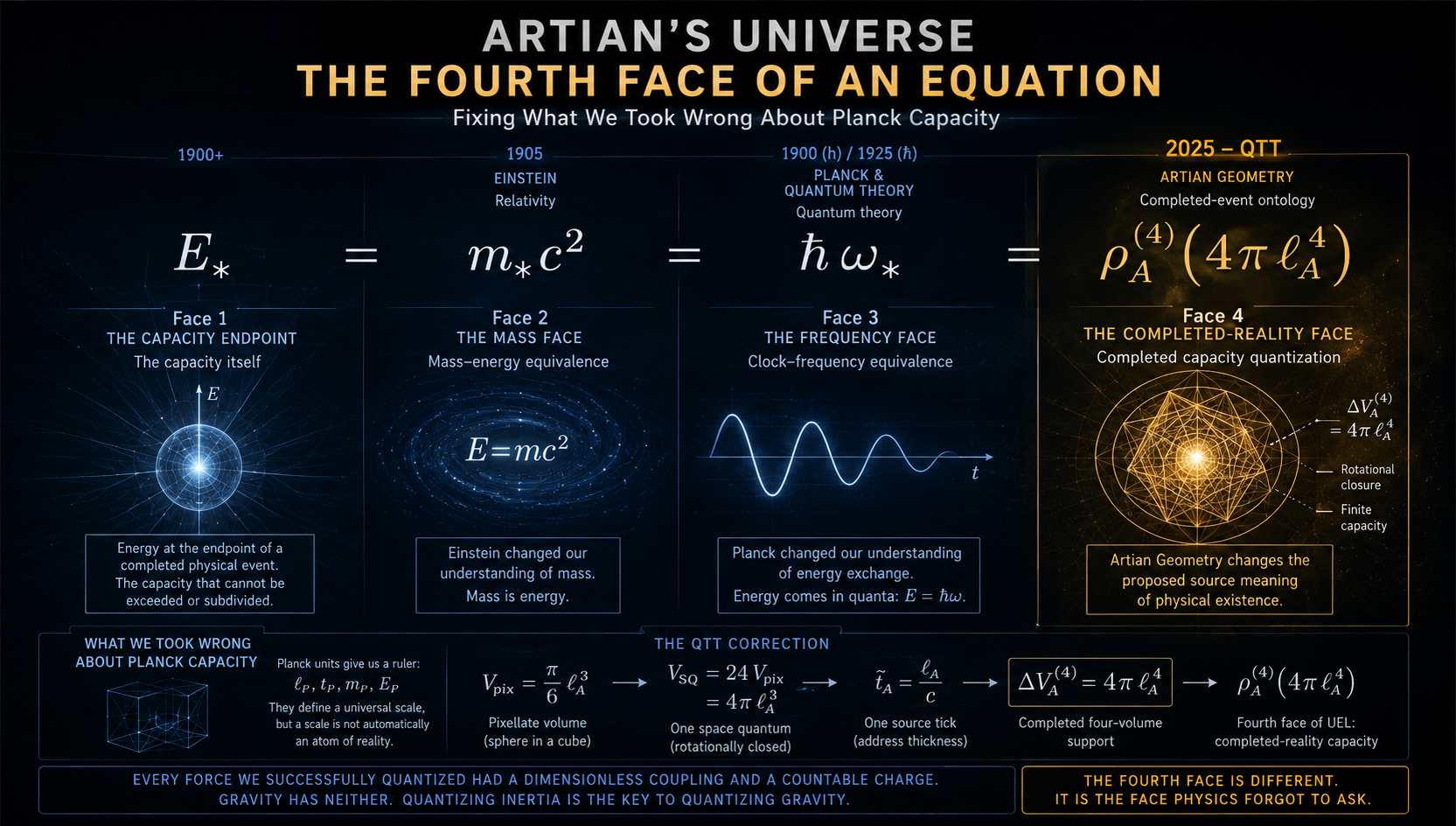
In the QTT source language, a completed address event has three conditions: a closed bundle, one reduced-action spend, and one rotationally closed four-volume. The experiment does not compare this source event directly with a fringe image.
Seven bins. First harmonic. No after-the-fact choice.
The primary branch is fixed as R = 7, n = 1, κ1(v) = 1. For a Talbot variable τ(v) = hL/(d2mv), the source rule takes the distance of n2τ from its nearest integer, maps that gap to an integer chamber count, and then gives a factor that is fixed before a residual is examined.
At exact closure, Δn = 0, the preregistered convention is δG,n = 0 and FnA7U = 1. The source rule has no visibility-data input.
sA7U = (0.144303, 0.078680, 0.037152, -0.007578, -0.025847, -0.112939, -0.113772)
The source-only vector has norm 0.234134390254 and peak-to-peak span 0.258074615057. Its equal-error five-sigma design target is σlog V = 0.046826878051. Those values are a sealed feasibility target, not a laboratory result.
| Bin | Velocity range | N range | Rep. N | Mean F | s |
|---|---|---|---|---|---|
| 1 | 143.196-149.713 m/s | 8-11 | 9 | 0.776015 | 0.144303 |
| 2 | 149.713-153.464 m/s | 7-8 | 7 | 0.726726 | 0.078680 |
| 3 | 153.464-156.543 m/s | 6-7 | 7 | 0.697164 | 0.037152 |
| 4 | 156.543-159.457 m/s | 6 | 6 | 0.666667 | -0.007578 |
| 5 | 159.457-162.536 m/s | 5-6 | 6 | 0.654598 | -0.025847 |
| 6 | 162.536-166.287 m/s | 5 | 5 | 0.600000 | -0.112939 |
| 7 | 166.287-172.804 m/s | 4-5 | 5 | 0.599501 | -0.113772 |
The representative integer vector (9, 7, 7, 6, 6, 5, 5) is for audit readability only. The primary construction integrates the full pointwise integer rail over each velocity bin; it does not replace an integral with one representative number.
A good-looking residual is not enough.
The ordinary null remains present throughout: observed visibility equals a block-wide apparatus factor times the established quantum/environmental prediction, plus error. After legal profiling, the null shape is zero. A free residual spline is not allowed to enter afterward and compete with a target it was designed to imitate.
The protocol is strict about what it can say.
A passing blind result would be evidence for the locked completed-event access branch. It would not by itself measure the fourth-face normalizer 4πℓA4 in SI units. That stronger claim would require an independent chamber identity and independent non-G metrology of the Artian ruler.
If any activation gate fails, the only legal outcome is target-not-activated, missing-object, or insensitive. It is not a theory verdict. If a fully admitted and sensitive primary packet gives the preregistered Red outcome, it falsifies the locked (R, κ, n) = (7, 1, 1) channel. It does not authorize anyone to silently swap in a robustness branch.
The package also keeps three things separate: a source-only feasibility vector, a physical instrument prediction, and an observation. Treating the first as either of the latter two is the error this protocol is designed to prevent.
Open the sealed technical ledger
The frozen access tuple is m = 171.283763350052 kDa, d = 133 nm, L = 0.98375 m, and v distributed as N(158, 92) m/s. At v0 = 158 m/s, τ1 = 0.820002377130474, Δ1 = 0.179997622869526, and NΓ,1 = 6.
The confirmatory harmonic set is n = 1 through 12 at v0. The n = 10 near-closure feature is sealed at 102τ(v0) = 82.0002377130474, so Δ10 = 2.37713047 × 10⁻⁴, NΓ,10 = 4207, and F10A7U = 0.999524601854. It may strengthen a successful primary test; it may not rescue a failed one.
The primary covariance is the full seven-by-seven log-ratio covariance, including fit uncertainty, uncertainty and correlations in the ordinary comparator, velocity-bin migration, common contrast/detector factors, and blockwise environmental calibration. Its specified nuisance space starts with one apparatus-block mean. The projected-space inverse is Moore-Penrose; any numerical regularization must be set and simulated before data access.
Below Rsens = 3 the result is INSENSITIVE; from 3 to below 5 it is CANDIDATE. A decisive packet has Rsens ≥ 5. A Green candidate further requires pA7U ≥ 0.05, Δχ2 > 0, zparallel ≥ 3, and an amplitude consistent with one inside the prescribed window. The preregistered Red condition requires Rsens ≥ 5, pA7U < 0.003, and |zparallel| < 3, stable through every declared control.
Forbidden choices include per-row contrast factors, post-hoc bins or harmonics, fitting κ, taking NΓ from visibility data, residual-driven covariance inflation, residual-driven environmental terms, changing the closure tolerance, replacing the primary branch after unblinding, or masking a disagreeing bin without a preregistered detector-quality reason.
A7U-FLOOR-OBSERVATION-PENDING.
For the source context, see Quantum Traction Theory: Main Book v10.01, especially completed-event and Artian-ruler material on pp. 52-61 and Unified Equilibrium Law context on pp. 212-214. Book concept DOI: 10.5281/zenodo.17527179.