Artian's Universe: The Fourth Face of an Equation
Fixing what Planck-scale language did not yet say about completed physical capacity.

There is an equation that looks familiar until its final equality. Mass is a reading of energy. Frequency is a reading of energy. QTT adds a model-native fourth reading: the finite capacity required for a completed source event to possess legal four-volume support.
The last expression is not an extra unit conversion and is not the ordinary statement E = ρV. It is QTT's claim that completion itself belongs to the source ledger. Its scientific standing is therefore the standing of that QTT construction and its stated premises, not a replacement for established Planck-unit physics.
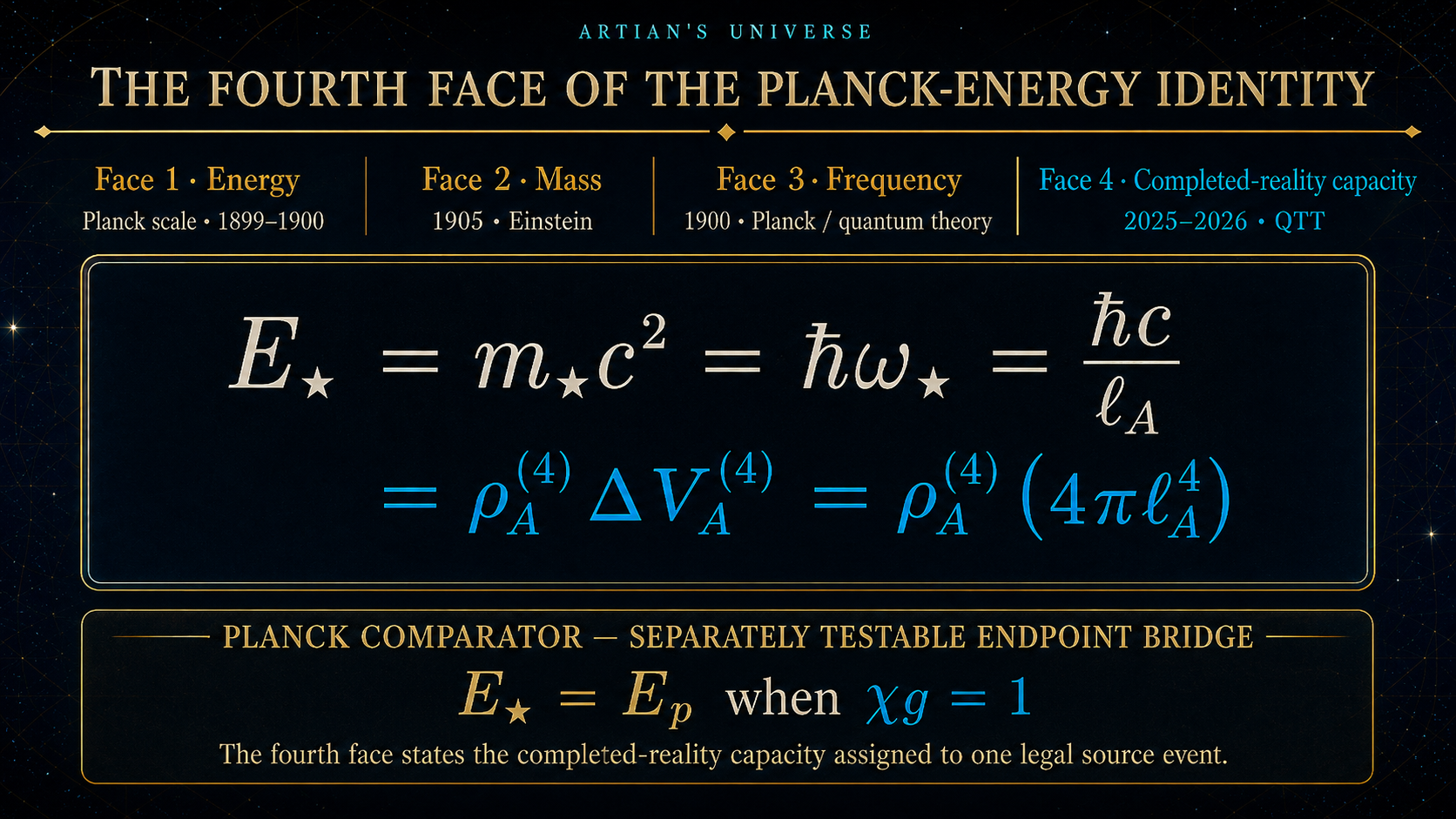
Planck supplied a ruler. A ruler does not specify what it measures.
Einstein's relativity supplied E = mc2. Quantum theory supplied E = hν = ℏω. Maxwell's electromagnetic theory helped establish the role of c; Planck introduced h and the natural-unit programme. Those statements do not establish an atom of physical reality, a minimum lattice cell, or a completed event ontology.
Planck units are constructed scales. The Planck length alone does not demonstrate discrete space; Planck time alone does not demonstrate indivisible ticks; a bare power of a length does not establish a legal source cell. That distinction is the guardrail here.
Planck units supply the ruler; Artian rotational closure supplies the QTT quantization claim.
A rotationally closed event, not a cube declared fundamental.
The proposed construction starts from the Artian ruler ℓA and asks what finite source geometry can represent a completed capacity event without treating three arbitrary coordinate axes as the primitive. The pixellate and space-quantum relations are:
One source tick supplies one Artian address thickness, t̃A = ℓA/c. The last relation is consequently a QTT source construction, not a claim that a hypercubic lattice is physical.
The fourth face is a condition of event legality.
The modular condition counts a completed same-universe bundle. The action condition supplies one reduced-action spend. The four-volume condition supplies legal Artian reality support. In the framework's source language, an event enters the source ledger only when all three are closed together.
The Artian Lagrangian writes these as constraints on a legal source event; the Hamiltonian framework gives the corresponding completed-event definition and relates the same event to E* = ℏ/t̃A = ℏc/ℓA. The multipliers enforce the stated event conditions; they are not fitted physical constants.
Capacity per completed four-volume.
Its dimensions are energy per length to the fourth power. It is not ordinary three-dimensional energy density. Ordinary density asks how much energy is present in a spatial region at a selected time. This QTT term asks what capacity the source model assigns to one legal completed unit of reality support in space and source time.
Why 4π is not decoration in this construction.
A naked ℓA4 is a coordinate measure. The proposed QTT face instead belongs to a declared closure chain: the pixellate factor π/6, the 24-pixellate space quantum, its 4π volume, and the surface relation below. The claim is not that every theory must use those numbers. It is that QTT uses them as one finite source grammar.
The novelty is the constructor, not multiplying density by volume.
Once density and volume are defined, E = ρV is elementary algebra. The QTT claim is narrower and stronger: the source model fixes the bundle condition, action spend, and rotationally closed four-volume together as the legality conditions of a completed event. That is what gives the fourth term its intended ontology.
The construction must also keep its ordering. In QTT source language, event closure precedes ℓA, which precedes t̃A, the endpoint E*, and the four-volume. A downstream comparison with Planck scales or gravitational readouts does not license reversing that order and calling the result a source derivation.
For the current book anchors, see Quantum Traction Theory: Main Book v10.01: Planck-scale guardrail p. 3; completed-event and Artian-ruler context pp. 52–55; and the Unified Equilibrium Law pp. 212–214. Book concept DOI: 10.5281/zenodo.17527179.