Why We Need to Redefine What We Mean by G
The 2019 SI did not change gravity. It made a second exact coordinate explicit.
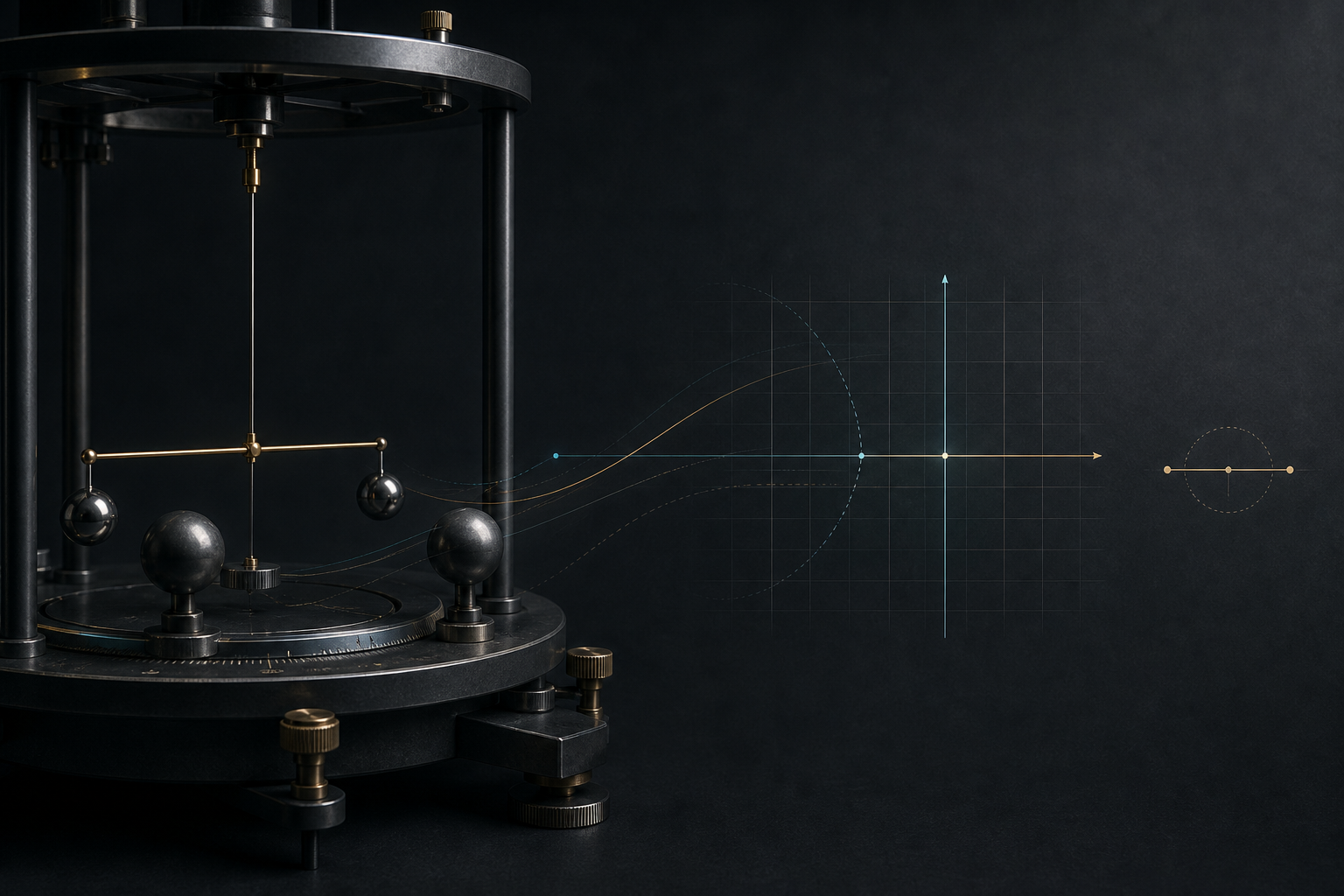
We were taught that a Cavendish experiment measures the gravitational constant. That is useful shorthand. It is not a complete account of what the apparatus actually does.
A torsion balance records a twist, a period, geometry, calibration records, and environmental corrections. A declared apparatus-and-gravity model turns that record into a local gravitational response coefficient. Only then does a conventional Planck-coordinate calculation become available.
The superscript M matters: it records the stated model under which the instrument record has been interpreted. It is not a disclaimer; it is part of the measurand.
The exact conversion is simple. Its interpretation is not.
The revised SI fixes the numerical values of c and h; therefore the reduced Planck constant, ℏ = h/(2π), is exact as well. The Newtonian gravitational constant remains experimentally inferred. For any positive, model-labelled local response, the coordinate transformation is exact:
This is one measurement in two exact coordinates, not two independent discoveries and not, by itself, evidence for a microscopic length limit.
The point is not to make a familiar square root sound mystical. The point is to stop allowing a coordinate rewrite to silently inherit a physical interpretation that the instrument never measured.
One G is usually doing four jobs.
For positive couplings, this is an exact algebraic gate. A theory may cross it by demonstrating that the roles are the same. It does not cross it merely by printing the same letter in four places.
The Big-G scatter is Planck-coordinate scatter.
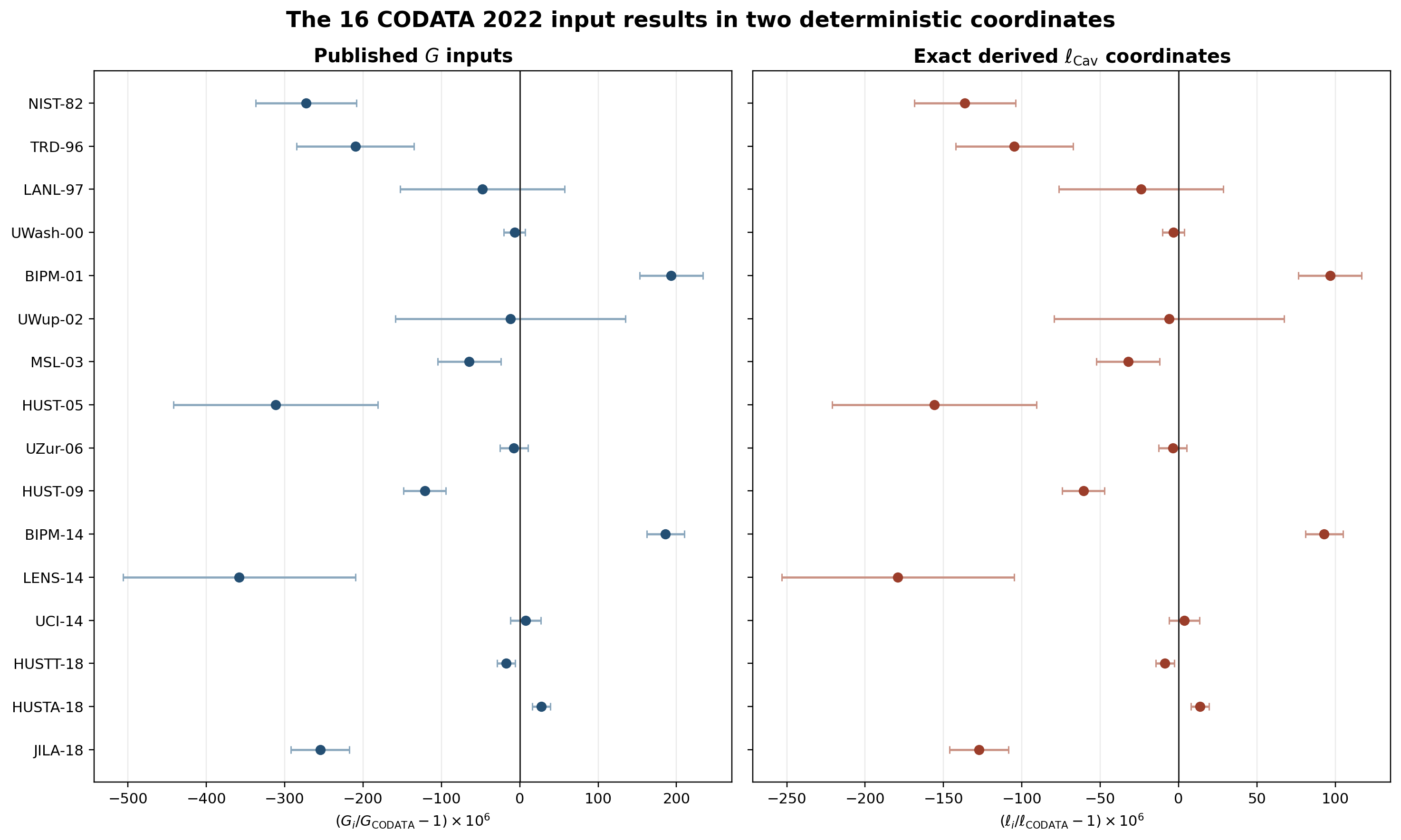
Different precision determinations of G have long displayed a broader spread than anyone finds aesthetically satisfying. The exact map does not create a second metrological crisis. It tells us something sharper: every disagreement in a reported local G is the same disagreement in its associated conventional Planck coordinate, with half the relative uncertainty.
What this correction does and does not buy us
Force the measurand, inference model, uncertainty transport, and claimed physical equality to be named separately.
Demonstrate a directly resolved microscopic length, a universal physical cutoff, or independent evidence for quantum gravity.
That distinction should be boring. It is not. It is the point at which familiar notation begins quietly performing physics that no apparatus has yet supplied.
A source relation is not a laboratory observation.
Quantum Traction Theory proposes a source-side relation in which the laboratory gravitational coupling is not primitive:
That relation is a QTT source claim. A Cavendish result is a laboratory-access result, so the metrological transfer must still be tested rather than declared successful from a matching coordinate. The full A2 gravity correspondence packet already carries endpoint faithfulness, χg = 1, as an explicit inherited clause. The Tier-K preregistration freezes a narrower source-to-laboratory transfer implementation with a no-retune rule. It can fail on its own terms without turning the upstream source normalization into a new fitted knob.
QTT Main Book v10.01, stable concept DOI 10.5281/zenodo.17527179. The noncircular Artian address-ruler distinction: pp. 60-61. Non-G ruler anchors and the electromagnetic-capacity guardrail: pp. 64-70. Endurance renewal and the gravity bridge: pp. 198-200.
The first two sources support the metrological statements about the revised SI and the current CODATA reference database. The QTT records state a source construction under the full A2 gravity packet and a separately sealed Tier-K transfer test; neither the target-visible comparison nor the pending transfer test is presented here as a new laboratory observation.
- BIPM, The International System of Units (SI), 9th editionThe revised SI definition structure and its official 2026-updated brochure.
- NIST/CODATA Fundamental Physical ConstantsThe current public NIST reference surface for the CODATA 2022 constants and correlations.
- Cavendish Measurements in Planck CoordinatesThe public paper carrying the exact-coordinate theorem, model-labelled measurand classification, and executed CODATA packet.
- Tier-K transfer preregistrationThe weakened-premise counterfamily and frozen transfer implementation are tested without reopening endpoint faithfulness in the inherited A2 source packet.