Testing Counting Entropy
It asks whether Boltzmann multiplicity is the only physically accessible count, or whether completed history leaves an independent timing signature.
The retreat
In 1872 Ludwig Boltzmann published the equation and theorem now known as the Boltzmann equation and the H-theorem. Under the Boltzmann equation's collision assumptions, including molecular chaos, the quantity H could not increase. It was a serious attempt to obtain macroscopic irreversibility from microscopic mechanics.
But it was not an irreversible law falling out of bare reversible mechanics alone.
Josef Loschmidt saw the problem in 1876. Reverse every molecule's velocity in a valid entropy-increasing trajectory. The reversed trajectory is also allowed by the mechanical equations, and it runs the other way. If one history increases entropy, reversible mechanics permits a time-reversed partner. Mechanics by itself does not choose between them.
Boltzmann's answer in 1877 changed physics. He stopped treating every entropy-decreasing microscopic state as forbidden and made probability carry the arrow: overwhelmingly more microscopic arrangements correspond to equilibrium-like macrostates than to specially ordered ones. The relation later written as
became the compact symbol of that move, and the equation eventually carved above his grave.
It was magnificent. It was also an honest retreat. The Second Law was no longer an unconditional monotone derived from reversible mechanics for every legal microscopic history. Entropy decrease was permitted but made fantastically improbable.
In 1896 Ernst Zermelo pressed the other side of the same wound using Poincare recurrence. A bounded, measure-preserving system on a finite-measure state space returns arbitrarily close to earlier states. Any single-valued state quantity that rose strictly forever would eventually be asked to take two different values at effectively the same state.
Boltzmann was right that the recurrence times for macroscopic systems are physically enormous. Zermelo was right about the theorem's premise. Practical irreversibility survived. An exceptionless state-space monotone did not.
I want to be exact about what was gained and what was lost. Physics gained statistical mechanics. It lost the claim that the arrow had been obtained from reversible mechanics alone.
Boltzmann then had to defend two things at once: a probabilistic Second Law and the physical reality of atoms that many influential scientists still treated with suspicion. In September 1906, while staying in Duino near Trieste, he died by suicide. Einstein's 1905 Brownian-motion paper was already in print; Perrin's decisive experiments and Ostwald's public acceptance of atomism followed in 1908-1909. Boltzmann did not live to see that experimental settlement.
I dedicated my main entropy paper to him. This post is about the second thing I owe him.
The question I keep coming back to
Loschmidt and Zermelo do not show that thermodynamics is useless. They show something more precise: reversible or recurrent dynamics cannot supply a strictly one-way function of the same instantaneous state without an additional asymmetric premise.
Boltzmann entropy is a multiplicity attached to a present macrodescription. One chooses which microscopic distinctions the macrodescription ignores, then counts the compatible microstates:
It answers a profound question: How many microscopic arrangements are compatible with what I can presently distinguish?
But it does not answer a different question: How many physical events have actually completed?
That difference is the entire wager.
Suppose the physical state is not exhausted by the projected configuration x(T). Suppose it also carries a completed-record coordinate Nrec(T):
Then a return of the visible configuration need not be a return of the full record-bearing state:
Loschmidt can reverse the momenta in x. That operation does not, merely by being a reversal, prove that completed records have been deleted. Zermelo can return x close to an earlier point. That does not prove recurrence of (x, Nrec).
This does not repeal Poincare recurrence. It exposes the exact burden. If the full record-bearing universe is still a fixed, finite-measure, measure-preserving state space, then its record capacity must eventually saturate or recurrence must be faced again. A completed-record theory has to identify which recurrence premise fails, or what happens at saturation. The word ledger is not permission to skip that proof.
So the real question is not whether Boltzmann's counting was wrong. It was not. The question is whether W was the only physically meaningful count.
What the latest corpus now says
The newest entropy paper keeps the two counts separate:
They can be related under finite-alphabet assumptions, but they are not identified.
Inside the declared Artian/QTT source class, the completed-record theorem and the access-production theorem give a two-component law:
with the corresponding no-extra-relative-weight scalar form
The current paper also corrects an earlier type error. A2 support is not a negative completed record, so 24 − 1 = 23 is not a universal entropy increment. The exact 24 belongs to the source-volume rail:
For an Artian mass inventory B=M/m_A present together at the first counted tick, A2 assigns one full support packet per B per tick, while A3 supplies the persistent White-Void/SQ creation family:
If the first two counts are separately subtracted, 23B appears only at N_T=1; the general result is BN_T(12N_T+11). The entropy theorem does not use that subtraction. Its global sign comes from completed-record persistence on the A1/A7 rail, while its local sign comes from standard data processing.
This is the strongest honest status: the monotonicity and recurrence-separation theorems are closed conditional derivations from the printed QTT source premises. Those premises are not established physics. The theorem does not derive microcanonical equiprobability from nothing, does not erase every initial-condition question, and does not yet prove that a laboratory can identify Nrec independently of its chosen description.
That last sentence is why I sealed a test.
What I sealed today
A "completed record" that no laboratory can distinguish from a memory convention is ontology without an operational receipt. The parent framework, blind-test preregistration, access theorem, and newly sealed dynamic-circuit extension attack that exact weakness from distinct sides.
The framework separates four objects that are too often compressed into one:
- a completed historical event — what the source claim says has finished;
- a presently accessible memory — what an instrument can still read;
- a coherent-recovery verifier — what tests whether branch information can be physically uncomputed;
- a timing-alignment projector — a different object, on a different space, with a separately calibrated readout.
The first separation is categorical, not cosmetic:
The word fan-out is also typed. In the source-volume theorem it means the A3 family of twenty-four White-Void fronts. In the sealed laboratory test it means one to four named memory carriers. The experiment varies only the latter. It cannot confirm or falsify the number 24, the A2/A3 volume ledger, or any 23 claim.
Completed history, accessible register size, and present record-state entropy answer different questions.
The second deposit is a sealed blind-test preregistration. The target law, control ladder, holdouts, eighteen eligibility gates, global decision threshold, terminal classifier, and analysis code were fixed and hashed before a laboratory sees target data.
The third is Observation as Access v7.0, which now includes both the formal projector discipline and an executed, target-blind ordinary access camera on public data.
The newest platform extension is the Dynamic-Circuit Completed-Record and Timing-Access Extension. It inherits the parent's eighteen eligibility gates and adds twelve platform-specific gates, for thirty gates on that implementation only. Its starting dynamic-circuit archive was independently reconstructed in 161 of 161 checks. No target-bearing data were used. Its status is sealed preregistration, observation pending. The parent blind test still has eighteen gates; the extension does not retroactively rename them as thirty.
Stage A: first prove the apparatus is doing what its label says
Let the two branch-conditioned record states be ρR(0) and ρR(1), with root Uhlmann fidelity
When the declared coherent controls are Uhlmann-complete, the best normalized recovered-coherence weight is
The test must distinguish coherent uncomputation from a memory reset. For every completely positive trace-preserving operation 𝓔R acting only on a discarded record,
So clearing a local register cannot change the unconditional reduced state of the system. A conditional quantum eraser may recover interference in selected subensembles, but then every outcome, no-click event, environment, feed-forward command, and discarded port belongs in the terminal packet. Genuine unconditional recovery requires joint coherent uncomputation of every branch-correlated degree of freedom.
Stage A asks whether the apparatus can do that and whether tomography correctly predicts the recovery envelope.
Passing Stage A is not evidence for QTT. It certifies that the apparatus, tomography, and coherent-recovery controls are qualified to open Stage B. If Stage A fails, the run is ineligible and no QTT verdict is allowed.
Stage B: make the record answer a question in another channel
Stage B asks whether the independently reconstructed record weight controls a separately calibrated timing-frequency covariance frontier.
This is where the new physics would have to live.
The pair-conditioned Uhlmann verifier MUop and the timing-alignment projector Palign do not become equal because their symbols look convenient beside each other. The experiment must construct and freeze a physical isometry W satisfying
before any timing holdout is opened. Only then is the bridge
licensed.
The timing observable is a dimensionless covariance area,
and the general registered bound keeps the physical transfer and finite boundary visible:
Only after the intertwining, centrality, transfer calibration, finite-boundary audit, and saturation-complete timing control have all passed does the canonical zero-boundary target reduce to
In ordinary language: the part of the branch record that can be coherently recovered and the registered timing uncertainty left by the unrecovered part must close one common ledger. But that sentence is a conclusion only after every antecedent above has been earned.
A five-point straight-line law, not one lucky point
The test does not ask one setting to land near one attractive number. Its canonical registered target is the straight-line complement
So when the horizontal coordinate is Fjoint2, the target has slope −1 and intercept 1. The five corridors sample that one frozen line; they are not points selected after seeing data.
It uses five source-blind squared-fidelity corridors,
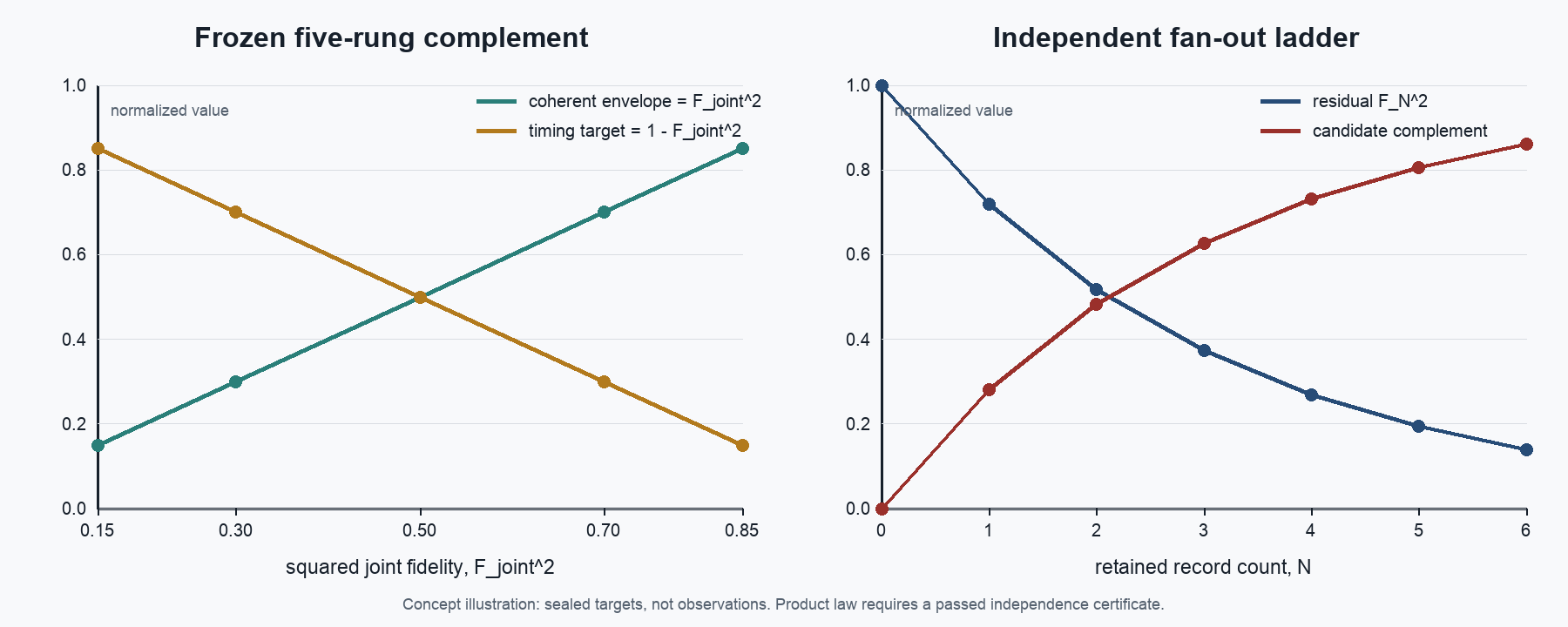
and a complete (N, m) ladder with one through four written records and every lawful uncomputation depth. For independent residual records,
Here is the simple example from the draft, now stated with the right quantity. If each independent record carries a squared fidelity/recovery weight Fj2 = 0.9, the canonical timing complement for one through four retained records is
Calling 0.9 the root fidelity would be wrong here; root fidelities would be squared again. That small terminological distinction changes the whole numerical ladder.
The preregistration adds physically different topology twins at equal joint fidelity, hidden-record injections, sham uncomputation, a local-reset negative control, complete terminal records, frozen ordinary cross-coupling models, and an independent record technology. At least one third of settings remain untouched holdouts. Theory decisions require a global 5σ rule; 3σ is diagnostic only. Planned power must be at least 0.95, or the theory verdict is forbidden.
This is not designed to make a preferred branch easy to declare. It is designed to make a wrong declaration difficult to survive.
What the newest public-data execution does — and does not — settle
The corpus no longer says merely, "no relevant data exist." Observation as Access v7.0 now executes an ordinary, target-blind access camera on the public Wettzell G-ring products: 1,063 complete three-hour rows spanning 132.75 days, five measured access channels retained, and zero QTT target-trained camera coefficients.
That is useful. It demonstrates a clean source-to-camera-to-record discipline on real data.
It still cannot decide this test. The released correction-to-residual hierarchy is an ordinary instrument-camera quantity. It is not ηT, not 1 − ηT, not Fjoint2, and not an A1 constant. The archive has no independently reconstructed record verifier, no physically certified intertwining, no variable-fidelity fan-out ladder, and no separate timing projector of the kind required here.
So existing data can qualify the methodology. They cannot supply a retrospective QTT verdict. Nobody gets to discover this result after already seeing it, including me.
What I refuse to claim
I would rather print the limits than let a critic discover them for me.
The physical bridge is not proved. The standard Uhlmann recovery theorem is closed. The timing representation is closed conditional on the QTT algebra. Their physical intertwining remains an experimental certificate, not a notational identity.
This experiment does not directly re-prove the global Second Law theorem. It tests the operational record-to-timing bridge that would let a laboratory distinguish completed-record structure from a memory convention. An eligible failure kills that registered bridge in the declared theorem packet. It does not, by itself, rewrite every source-level entropy theorem in the corpus.
A positive result would be candidate evidence, not unique proof of an ontology. It must defeat the frozen ordinary comparator across all corridors, pass the topology twins, transfer to a second record technology, and survive untouched holdouts. Even then, another physical model might later explain the same shape.
A failed apparatus is not a failed theory. The parent test has eighteen gates before any verdict; the dynamic-circuit extension has thirty because it adds twelve platform-specific gates. If any applicable gate fails, the terminal status is INELIGIBLE_NO_THEORY_VERDICT.
An eligible failure cannot be withdrawn after unblinding. If every gate passes, the frozen QTT consequence fails at the global rule, and no registered anomaly branch accounts for the result, the terminal status is REGISTERED_QTT_CONSEQUENCE_FALSIFIED. The escape hatches are welded shut in both directions.
What would actually hurt
The sharp failures are not philosophical.
- If equal-fidelity topology twins produce unequal timing areas after the frozen ordinary coupling model and covariance, then one scalar record weight is insufficient or the bridge fails.
- If the full eligible ladder rejects ηT = Fjoint2 or the registered timing frontier at the global threshold, the preregistered QTT consequence is falsified for this packet.
- If completed-record identity cannot be made observer-independent and operational — if it reduces to a chosen coarse graining exactly as W does — then the proposed source entropy loses the distinction on which it depends.
- If the universe has a globally finite record capacity that saturates, the corpus must specify the terminal sector or face full-state recurrence again. That problem remains open.
Those are not footnotes. They are where the idea can break.
Why this one is for him
Boltzmann's critics were not fools and they were not villains. Loschmidt correctly showed that reversible mechanics cannot prefer one temporal orientation without an asymmetric statistical premise. Zermelo correctly showed that recurrence blocks a strictly monotone function of a recurrent full state. Neither objection was refuted by waiting longer; each was scoped by identifying what physics actually measures and on what timescale.
What I think happened is subtler than "Boltzmann was wrong" or "Boltzmann was right." He counted the physical object his century had learned how to count. Arrangements. Multiplicities. The combinatorics of a present macrostate. With that object, the move to probability was not cowardice. It was the honest move.
The new question is whether another object was there all along: completed physical history.
If the sealed bridge survives, it will not erase Boltzmann entropy. It will place a source monotone underneath it: kBNrec for completed history, kB ln W for compatible multiplicity, and access entropy for what a finite observer loses. That would make the retreat from law to statistical tendency look less like nature's final verdict and more like a consequence of having only one ledger open.
If the bridge fails cleanly, then this operational route from completed history to timing is dead. If completed records also turn out to be description-dependent in the same way as macrostates, then the deeper distinction collapses, and Boltzmann's retreat was not merely the best move available in 1877. It was the right move in principle.
I would rather be shown wrong by an experiment than be right in an essay. Boltzmann did not have quantum record tomography, coherent uncomputation, independent timing projectors, blind holdouts, or cryptographic preregistration. We do.
He defended counting when counting invisible events was not yet respectable.
The least I can do is make my count answer to an instrument.
Deposited 12 August 2026. Completed-Record Fan-Out and Timing-Access Reference Framework -- concept DOI 10.5281/zenodo.21902886. Record-Fan-Out Timing-Envelope Blind Test Preregistration -- concept DOI 10.5281/zenodo.21902885. Dynamic-Circuit Completed-Record and Timing-Access Extension -- concept DOI 10.5281/zenodo.21904993. Observation as Access -- concept DOI 10.5281/zenodo.20114403.
Scientific anchors. Entropy and Second-Law Reference Theorem -- concept DOI 10.5281/zenodo.20045306. Boltzmann Weighting from Finite Completed-Event Reservoirs -- concept DOI 10.5281/zenodo.20322035. QTT Main Book -- concept DOI 10.5281/zenodo.17527179, especially pp. 48-51, 181-188, 252, 435-438, and 529-530 for the record/access framework, and pp. 748-754 for the entropy synthesis in v10.01.
Reader routes. The Equation on the Tombstone · Access-Law Observatory row · Corpus Tree · ORCID 0009-0008-9931-2691
Historical checks. Boltzmann's work in statistical physics, Stanford Encyclopedia of Philosophy · English translation of Boltzmann's 1877 paper · Philosophy of statistical mechanics: reversibility and recurrence objections · Jean Perrin and the experimental evidence for molecular reality, Nobel Prize · Ludwig Boltzmann, University of Vienna
Scope note: the H-theorem, Uhlmann fidelity, trace-preserving reset identity, Poincare recurrence theorem, and standard quantum controls are established mathematics or physics within their stated assumptions. The completed-record source ontology and the record-to-timing law are QTT claims; the latter is prospective, conditional, preregistered, and not established textbook physics.
Related papers
Related Field Notes
Maps and definitions
Primary context and independent sources
The source, record, access, and entropy pages
QTT Main Book v10.01 · stable concept DOI 10.5281/zenodo.17527179.
- pp. 48-51: finite source ledger and completed-event bookkeeping.
- pp. 181-188: observation, access, projection, and durable terminal records.
- pp. 435-438 and 529-530: record persistence, recurrence separation, and access-law structure.
- pp. 748-754: entropy synthesis, completed records, multiplicity, and the Second-Law ledger.