Looking for One Lab to Test a Question Physics Has Not Yet Isolated
In a monitored quantum-recurrence staircase, does the physical reference class that schedules the measurements leave the transition position unchanged?
Published 1 August 2026 · prospective protocol · no laboratory result is claimed

If a group already runs stroboscopically monitored quantum dynamics - superconducting circuits, trapped ions, photonic walks, or another evolve-measure-restart platform - the underlying object is familiar. Unit evolution is followed by a detection attempt; after a miss, the system is restarted. The finite-horizon conditional mean develops resonance transitions whose infinite-horizon counterpart is governed by an integer winding structure.
The recent Wang-Yin-Barkai paper studies temporal interference at those monitored-dynamics topological transitions. That formalism is theirs; the narrower question here is new: once ordinary clock transfer is fixed, does a reciprocal switch between two physically qualified scheduler roles leave the location of the same transition invariant?
The important gate comes before the data
A free-running oscillator is not simply declared to be QTT's source-time terminal because it is less disciplined. The paper explicitly forbids that shortcut. Before the target can be tested, the lab must certify the scheduler roles, Hamiltonian lock, ordinary transfer, finite-horizon adequacy, role reciprocity, hidden control injections, blindness, and covariance model.
Gact = 0 means TARGET_NOT_ACTIVATED. A unity measurement from hardware that never realizes the stated terminal architecture cannot be used to falsify A1. It remains a useful bound on the ordinary scheduler comparison, but it is not a theory verdict.
What a candidate group would actually do
- 1Choose a finite-dimensional monitored-recurrence platform and identify predeclared phase-merger transitions. The integer plateaus are a standard-physics control; their coordinates are the registered observable.
- 2Freeze the clock-transfer and reciprocal role-swap packets before target blocks. Run injected frequency, latency, jitter, gain, and drift controls with hidden signs.
- 3Complete the activation certificate. If it fails, publish the eligible control result without overstating its reach.
- 4Only then unblind the frozen covariance-aware estimator and report one of the preregistered outcomes. No opened-data angle, multiplier, or exception may replace the two fixed targets.
Why this is a reasonable collaboration request
This is aimed at groups that already operate a monitored evolve-measure-restart experiment. It does not ask for a new facility. Its practical burden is a serious control problem: two qualified scheduler roles, a reciprocal campaign, a transfer calibration, and enough data to satisfy the preregistered uncertainty gate. Budget and duration are platform-specific and must be estimated by the laboratory rather than asserted here.
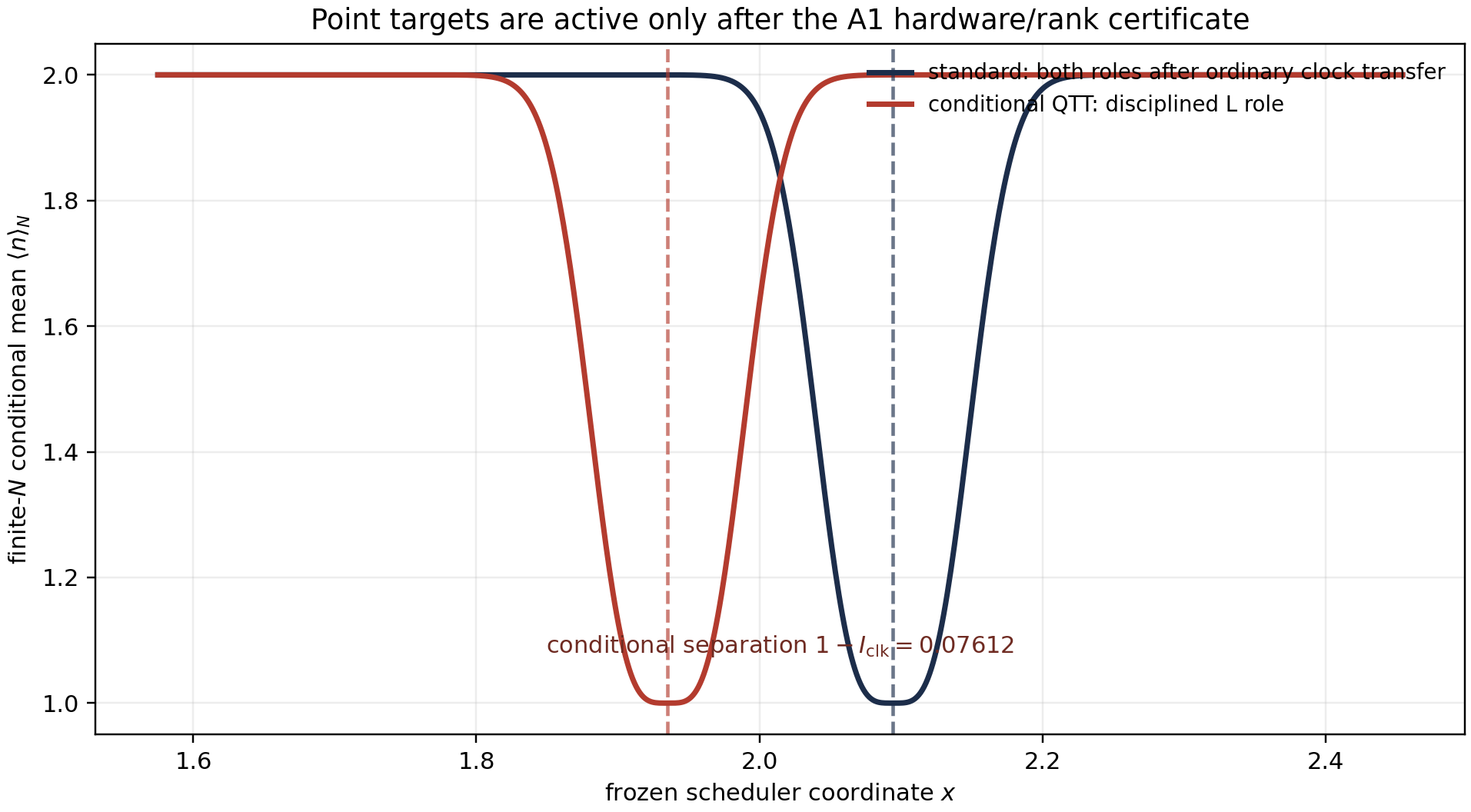
A qualified result near unity excludes the activated A1 time-map in this channel. A qualified result near the conditional QTT point is only candidate support until independent replication and a systematic review. A result near neither target rejects the two-point model. Those are the rules before anyone knows the answer.
The reference-switch reading path
The citable protocol and its controls
QTT Main Book v10.01, stable concept DOI 10.5281/zenodo.17527179. Direct anchors: source and laboratory clock distinction, pp. 158-160; Sagnac/reference-switch and the Folman trident, pp. 560-562; broader time and access ontology, pp. 47-52.