Where Is the Universe's Absolute Clock Hiding?
The sealed π/8 reference-switch test
On the ether that deserved to die, the two questions relativity leaves open, and one atom-chip experiment that can now ask whether source ordering is absent or merely inaccessible to ordinary clocks.
The absolute that deserved to die
Physics has killed an absolute background once before, and it deserved to die. The nineteenth century's ether was a mechanical absolute: a substance light waved in, a rest frame against which motion might be measured. Michelson and Morley looked for its wind in 1887 and found no convincing ether drift. Each rescue made the ether less necessary, until Einstein made the cleaner move: special relativity removed the mechanical medium from the foundations and made the local vacuum speed of light invariant.
General relativity then did something genuinely necessary. Without its metric dynamics, the anomalous perihelion advance of Mercury is not recovered correctly, GPS accumulates roughly ten kilometres of ranging error per day if relativistic corrections are omitted, the observed amount of gravitational light bending is not recovered, and clocks at different heights do not disagree as measured. I want to be exact here, because I have said it since 2019 and I will say it again: the mathematics of GR is only smaller part of the problem. The mathematics is working within certain limits extent, breaks obviously at Blackhole, and QTT uses its tested infrared shadow test.
The two questions left open
The problem is what the mathematics was sometimes made to say. A common ontological reading promoted the absence of an operationally preferred foliation into the stronger claim that no universal ordering exists. GR itself supplies no operationally privileged global “now”; that does not by itself prove every block-universe interpretation. The absence of a measured source ordering and the nonexistence of source ordering are different statements.
A second silence follows from the standard single metric proper-time structure. Ordinary clocks may follow different worldlines and accumulate different proper times, but the framework contains no separately observable source clock behind those metric readouts. It therefore cannot answer, from within that same one-clock channel, whether every clock is fundamental or whether laboratory time is the access image of a deeper completed-event ordering.
Where QTT says the clock hides
The old ether failed because it was a substance with a velocity, sought in the tangent world of rods and light. The A1 clock of the Artian/QTT model is neither. It is an ordering: a count of completed events. Within the declared local Einstein-gauge matter/gauge domain, the QTT Lorentz analysis gives no laboratory ABC vector and no local anisotropic kinetic tensor. Its one-loop Collins negative control has the exact response slope Δc′(1)=α/(12π), while the legal scalar regulator gives zero Lorentz-violating projection. The associated all-orders perturbative statement is conditional on the printed no-local-spurion hypotheses; it does not cover dynamical lapse or quantum-gravity loops.
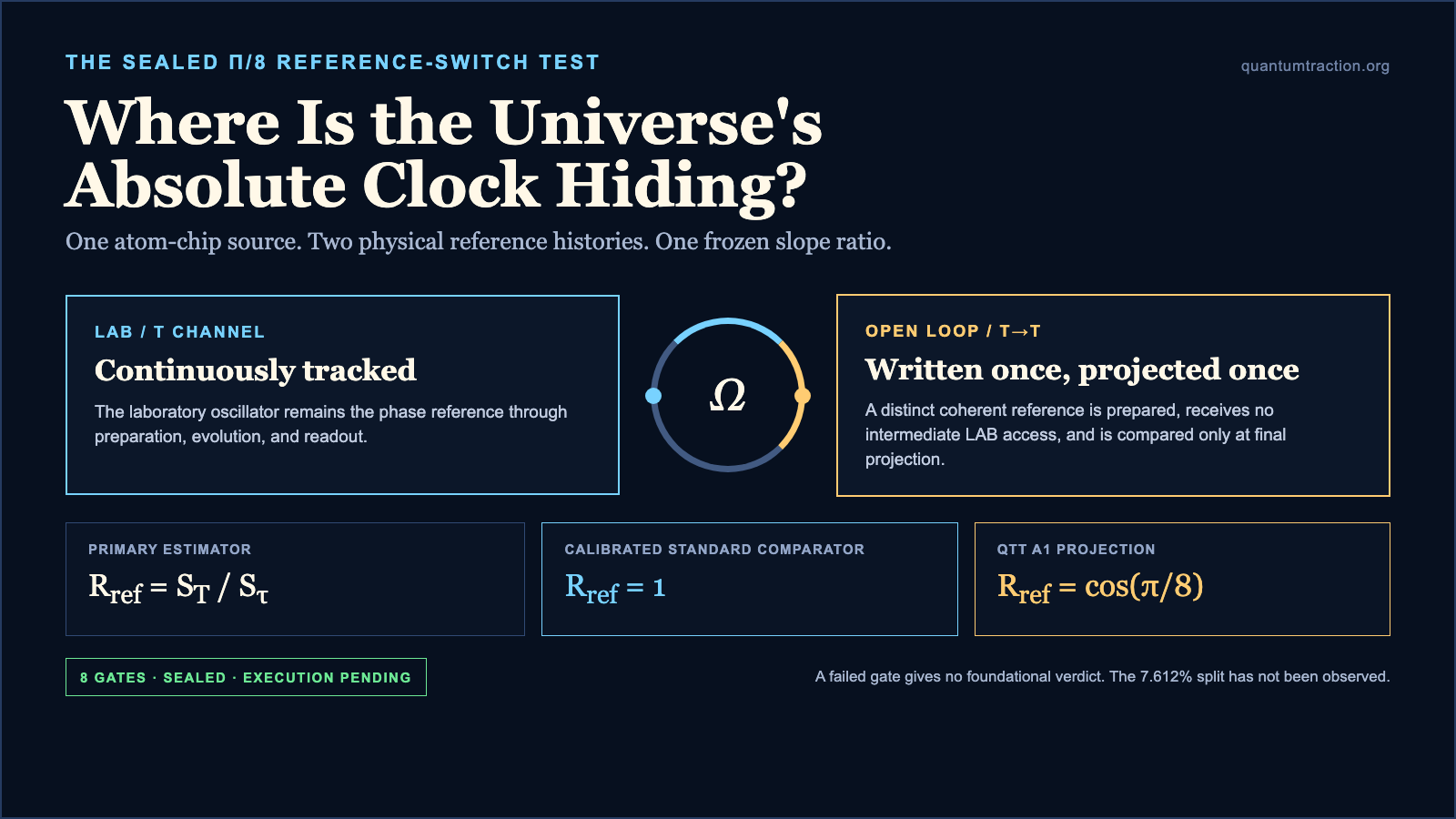
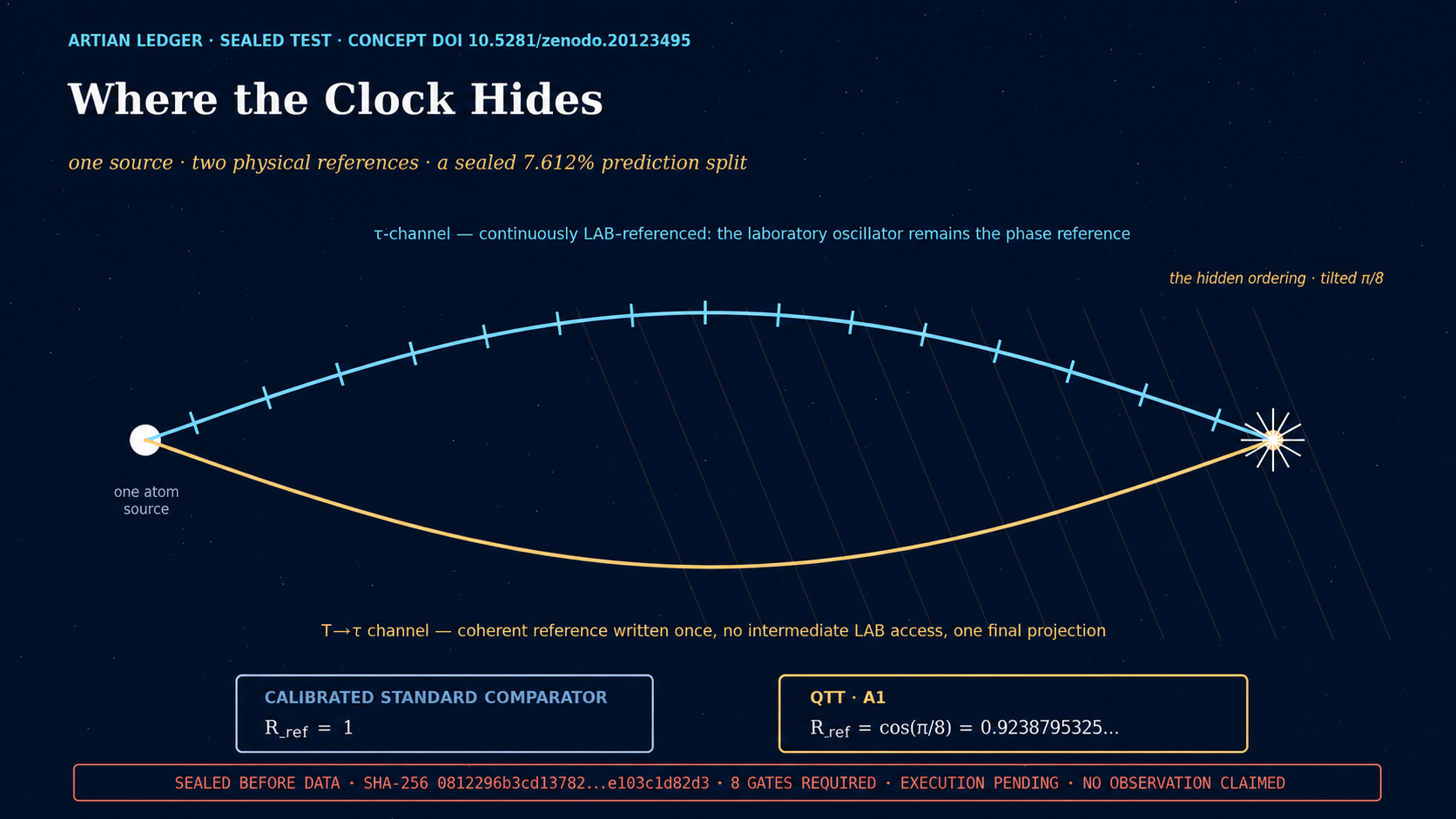
That scope matters. QTT does not predict an ether wind for an ordinary local preferred-frame search. Its present paper derives a different seam: change the physical reference history of one coherent phase. The laboratory channel stays tied to a continuously tracked oscillator. The open-loop channel uses an independently prepared coherent reference, receives no intermediate laboratory phase write, reset, measurement, or reconstruction, and meets the recombined matter wave only at the final projection.
A final measurement alone is not the test; every interferometer ends in a readout. The distinction exists only when the open-loop reference was physically prepared, remained inaccessible to the LAB record during transport, and survives all eight eligibility gates. Two reductions of one detector record are still one channel.
The number sealed before the data
The record published this week, The Folman Phase Spine and the Sealed π/8 Reference-Switch Test, turns that reference change into a frozen slope ratio. It uses the full-loop Stern-Gerlach atom-chip programme as the technological spine because that programme has already demonstrated self-interfering clocks, geodesic geometric phase, cubic Stern-Gerlach scaling, and complete Stern-Gerlach interferometry. Those results establish relevant capabilities. They do not constitute an observation of cos(π/8).
The corrected v4.0 primary orientation is
0.9238795325112867
The targets differ by 0.0761204674887133, or 7.612%. In the calibrated same-loop reference switch with no new physical coupling, metric GR plus ordinary quantum mechanics predicts unity. The QTT A1 access map predicts cos(π/8). There is no fitted interpolation. A qualified result near neither target rejects the sealed two-point model.
Eight gates before either side may claim a verdict
- 1Common source and loop. Both channels begin from the same declared preparation and geometry.
- 2Hardware-distinct instruments. Two names or reductions of one record do not count as two channels.
- 3No intermediate LAB access. The open-loop arm receives no measurement, reset, servo re-zeroing, or LAB reconstruction.
- 4Independent gain calibration. Injected-phase gains are frozen before unblinding and applied before the ratio.
- 5Duplicate nulls return unity. LAB/LAB and open/open duplicates must both close at one.
- 6Odd phase reverses. Signed rotation or area reversal flips the physical odd phase.
- 7Ratio survives ladders. It stays stable across area, rotation, pulse, atom-number, and block ladders.
- 8Complete audit record. Covariance, exclusions, calibration, and channel records must be available.
What each outcome would actually mean
- A qualified interval compatible with Rref = 1 and excluding cos(π/8) leaves metric GR plus ordinary-QM channel universality intact and falsifies QTT's printed A1 reference-switch projection for this channel. It does not prove every philosophical block-universe interpretation.
- A qualified interval compatible with Rref = cos(π/8) and excluding unity contradicts the calibrated single-time comparator for this physical protocol. Replication and systematic exclusion would then become mandatory.
- A qualified result near neither fixed target rejects the two-point model. No replacement angle may be selected from the opened data.
- Any failed gate means ineligible, not “fit again” and not a foundational verdict.
So this is the answer to the title. The absolute clock, if it exists, hides where the ether never did: not in a wind one flies through, but in the relation between a coherent record and the physical reference history through which that record becomes measurable. The experiment does not ask whether rotation creates a Sagnac phase; both descriptions already agree there. It asks whether a physically isolated reference switch leaves the slope at unity or at the A1 projection angle.
In 1887 the universe did not reveal a mechanical medium. This question is about ordering, not substance. Either outcome is scientifically useful because the targets, gates, and retreat routes are already public.
— Ali Attar, Quantum Traction Theory Project
The reference-switch reading path
Concept families and laboratory foundations
QTT Main Book v10.01, stable concept DOI 10.5281/zenodo.17527179. Direct anchors: A1 and the source/laboratory clock distinction, pp. 158–160; Sagnac/reference-switch and Folman trident, pp. 560–562. Broader time and access ontology: pp. 47–52.