Why G Comes Out This Way in QTT
The ontology behind the gravity word: a finite source ledger, one electroweak anchor, two endpoint tolls, and the endpoint-faithfulness clause stated openly inside the full A2 gravity packet.
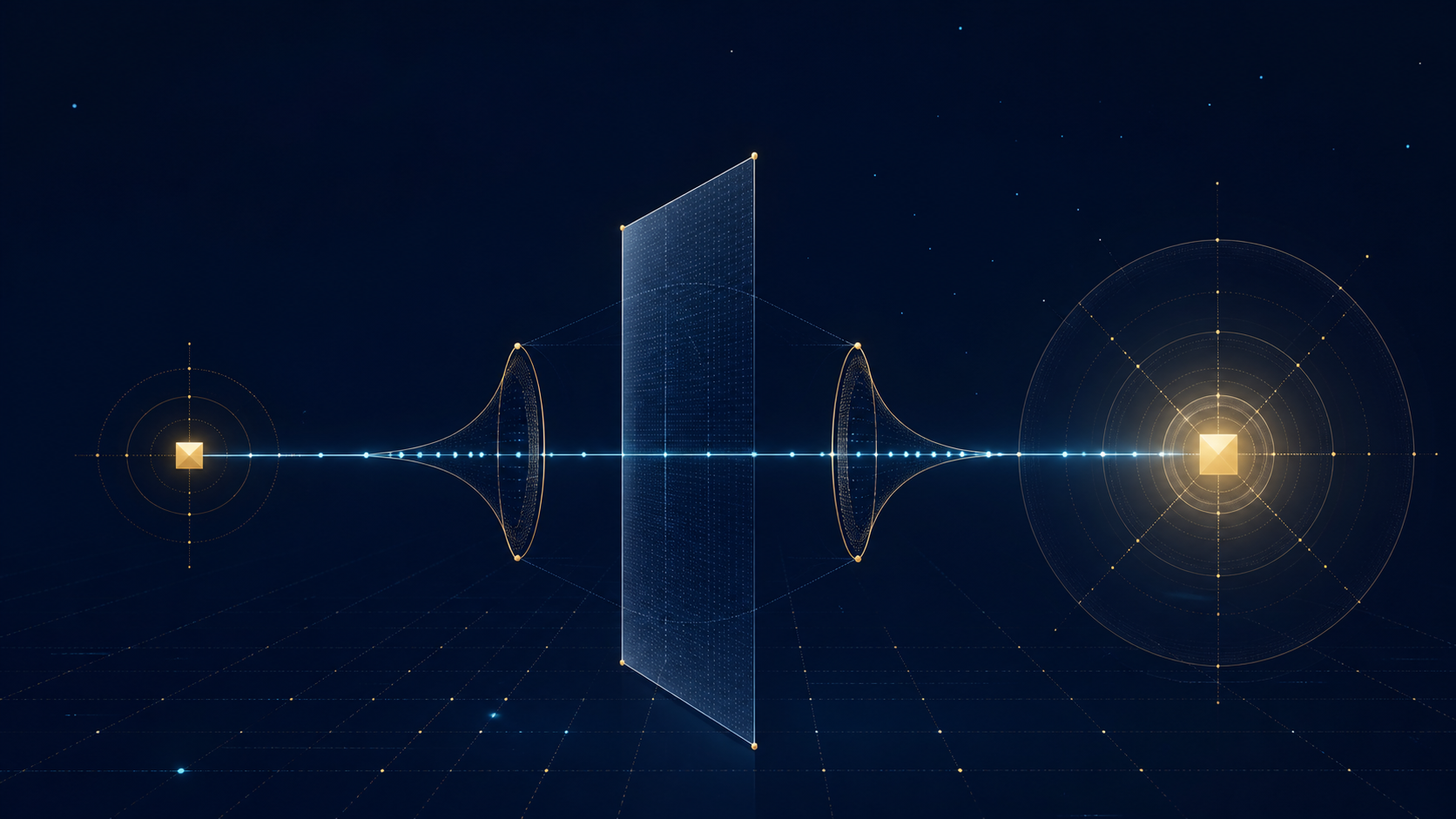
This is a full-packet, anchored gravity construction. The finite constructor classes and one weak-sector anchor are visible, and endpoint faithfulness, χg = 1, is an explicit inherited clause of the full A2 gravity correspondence packet. The Tier-K counterfamily proves that a weakened premise set does not recover that clause by itself; it does not turn the inherited clause into a fresh downstream fit. The CODATA comparison remains target-visible rather than a blind confirmation.
Newton's constant is usually introduced as a measured coefficient. QTT asks a prior question: if a finite source ledger is read through a laboratory interface, what kind of word could that coefficient be?
The answer is not “a number fell out of a calculation.” It is a chain of typed commitments: a tilted clock, a closed bundle, a finite interface, an electromagnetic readout, an electroweak anchor, and endpoint faithfulness. The point of this note is to show every link and its real status, without hiding an inherited clause and without demoting it into a knob each time a downstream transfer theorem is tested.
One anchor, two endpoint factors.
The Tier-K preregistration freezes G0 = 6.674300783009366 × 10⁻¹¹ m3 kg−1 s−2, using the pre-freeze Fermi anchor GF = 1.16637859(59) × 10−5 GeV−2. Its anchor-only standard uncertainty is 0.505839 ppm. The cited concept DOI carries the frozen payload and its no-retune test protocol.
A necessary chronology note: the current Gravity Reference Framework also prints a later source/readout audit branch. This field note discusses the separately frozen Tier-K target. It does not average branches, replace the preregistered target after the fact, or treat a later value as evidence for an earlier lock.
The distinction matters. A frozen test has to be allowed to fail on its own terms. Updating its target after seeing a later construction would erase the very discipline the test is meant to enforce.
The number is not one move. It is a waterfall.
Each station has a different logical status. That is not a defect in the story. It is the difference between a derivation one can audit and a slogan one cannot.
ρ = 2π cos(π/8)
A1 supplies the declared quarter-turn source clause; A4 supplies the spinor half-angle; A7 supplies the 2π closure. The half-angle and closure are theorem steps. The original quarter-turn is stated as a source clause, not smuggled in as a result.
qH = 2 exp[−4π2 − 1/(8ρ2)]
Inside the declared three-vertex topology, the unique simple path is bundle → lock → readout. The face action is (2π)(2π) = 4π2; serial capacities multiply as exponential weights. The selected topology remains class-relative.
αQTT−1 = 4π(8 + ρ/2 + λγ)
The five-rail word is discrete and minimal only inside its declared grammar. Its precision landing is a retrospective consistency audit; the published chronology does not permit it to be called a prospective confirmation.
RHEW = exp[−αQTT√(6 + ρ−2)/(8ρ2)]
A seven-component readout word provides the last small attenuation. The current certificate has multiple admissible survivors. That means the form is motivated and bounded, but the exact word is not uniquely selected across the full stated class.
The Fermi constant is spent once
A dimensionless source ledger cannot produce an SI gravitational coefficient without a declared dimensional bridge. The Tier-K construction uses one: GF. That makes its laboratory result an anchored Class-A audit, never a source-only SI closure.
χg = 1 belongs to the full A2 packet
If endpoint faithfulness is removed, the weakened premises admit the counterfamily 0 ≤ χg ≤ 1. That is a useful minimality theorem: it shows exactly what the full A2 packet contributes. Once that packet is adopted, χg = 1 is inherited and frozen, not reopened as a fitted downstream gain.
The primary source object is a count, not kilograms.
QTT writes the source mass statement as B = M/mA: the dimensionless Artian-mass count. A2 assigns a renewal burden to that count per source tick. Kilograms enter only later, when a laboratory comparison is made. This is why the gravity word is described as an endurance readout rather than an electrically charged interaction.
Within QTT's source ontology, universal free fall is the claim that every persistent object is read through the same endurance ledger. Whether this source statement recovers every laboratory gravity domain remains a separate access-map and observation question.
| Stage | Printed value | Status |
|---|---|---|
| ρ = 2π cos(π/8) | 5.80490630428 | A1 clause plus A4/A7 theorem steps |
| qH | 1.42613305081 × 10⁻¹⁷ | Unique within declared topology |
| αQTT−1 | 137.035999165998 | Retrospective constructor audit |
| RHEW | 0.9999335312550867 | Selected survivor; non-unique across stated class |
| Tier-K G0 | 6.674300783009366 × 10⁻¹¹ SI | One-anchor, frozen target; no hard evidence claim |
| χg = 1 | Endpoint faithfulness | Explicit, inherited, frozen clause in the full A2 gravity packet |
What is derived, what is measured, and what is inherited?
“Derived” is not one word for one achievement. A calculation can be exact after its inputs are stated, while the physical choice of those inputs remains a separate question. This is the full chain at its proper strength.
The first line is the standard laboratory definition of the weak ruler. The second is the QTT scalar-lock readout. Combine them and the capacity scale is fixed in terms of the one measured anchor, GF, and the finite QTT factors qH and RHEW. Insert that result into the third line and the Tier-K source value follows. The arithmetic is compulsory once those premises are accepted.
The no-go theorem asks a narrower question: what follows after endpoint faithfulness is removed from the premise set? Then a lawful family remains, Gend = χgGA, with 0 ≤ χg ≤ 1. This proves the full A2 clause is necessary and visible. It does not authorize a downstream paper to refit χg after the source normalization has already been inherited.
What would kill this branch?
For the source and access vocabulary, see Quantum Traction Theory: Main Book v10.01: source geometry and the Artian ruler, pp. 55–58; photon-edge and 64-door ledger, pp. 99–100; the scorecard, p. 35; two-clock ontology, pp. 235–237; and the projection and half-angle lemmas, pp. 541–553. Book concept DOI: 10.5281/zenodo.17527179.